
TMJ/TMD Physiotherapy in Noida
Jaw pain, clicking, or restricted jaw opening? Physiotherapy for TMJ/TMD in Noida with Dr. Ashok K. Anand — assessment-led care at Spectrum Mall, Sector 75.
Visit Ayursoul Physiotherapy Clinic
Ayursoul Healthcare, Spectrum Mall, Sector 75, Noida, Uttar Pradesh
Open daily: 10:00 AM – 8:00 PM
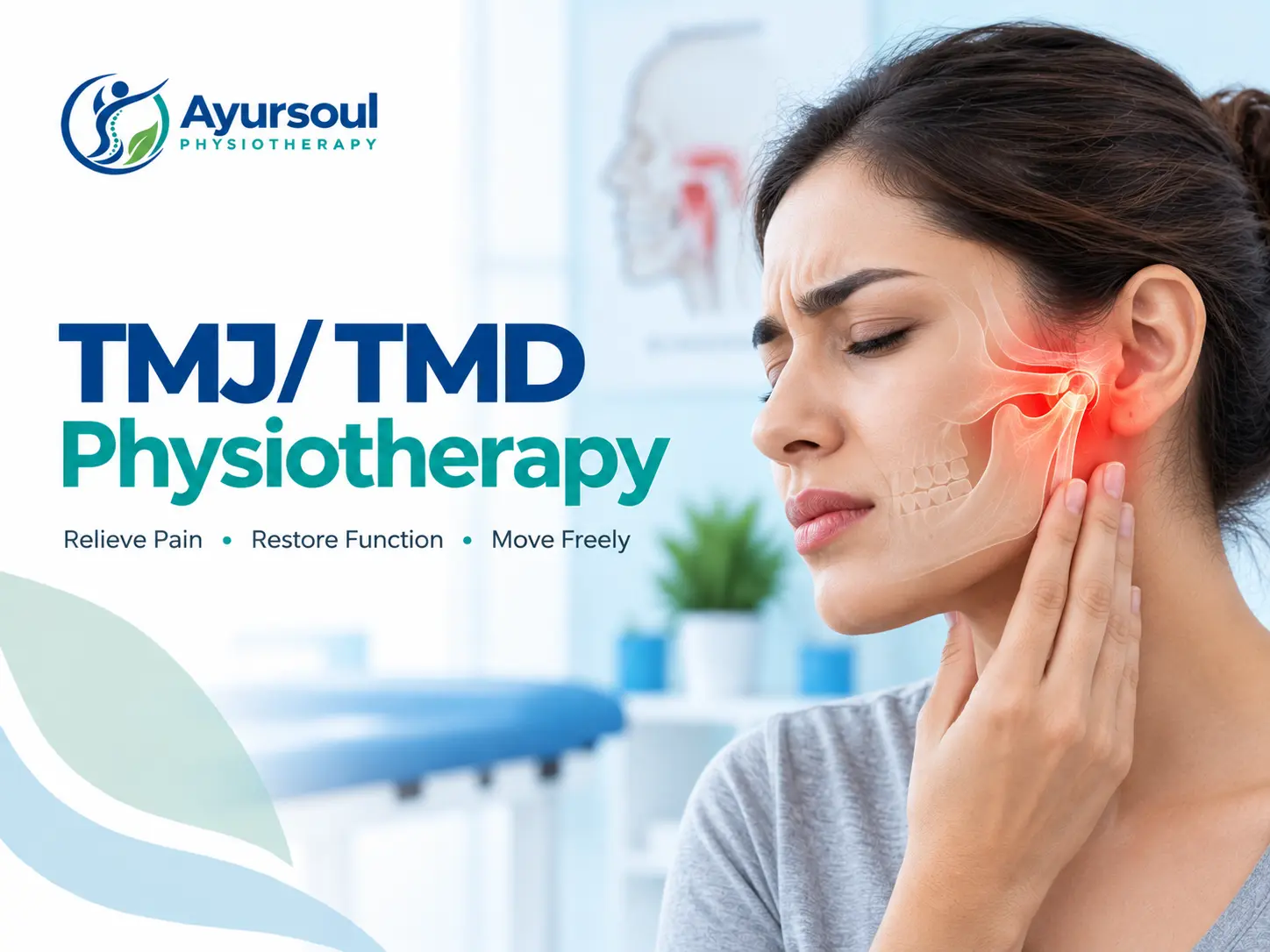
Need Help With TMJ/TMD Physiotherapy?
If jaw pain, clicking, or restricted jaw opening is affecting your daily life, book a physiotherapy assessment with Dr. Ashok K. Anand at Ayursoul Physiotherapy, Spectrum Mall, Sector 75, Noida, by calling +91 88003 68078.
Temporomandibular joint dysfunction, commonly known as TMJ or TMD, refers to a group of conditions affecting the jaw joint and the muscles that control jaw movement. It can cause jaw pain, an audible clicking or popping sound when opening or closing the mouth, and in some cases a feeling of the jaw catching or restricted opening. These symptoms may appear on one side or both, and their intensity often varies from day to day.
TMJ/TMD is fairly common and can affect adults of almost any age, though it is often reported by people who deal with high stress, teeth grinding or clenching, or who spend long hours in postures that strain the neck and jaw, such as extended desk or phone use. Some people also develop symptoms following a jaw injury, dental work, or as part of a broader joint condition.
Physiotherapy may help by addressing jaw muscle tension, movement restrictions, and postural contributors that are commonly associated with TMJ/TMD. It is generally used as part of a broader care approach and does not replace a dental or medical evaluation when one is needed — a physiotherapist can help clarify whether that kind of referral may be appropriate for your particular situation.
Common Symptoms of TMJ/TMD Physiotherapy
- Pain or tenderness in the jaw, temple, or in front of the ear
- Clicking, popping, or grating sounds when opening or closing the mouth
- Restricted or uneven jaw opening
- Jaw locking, either briefly or for longer periods
- Facial pain or aching, especially after chewing or talking at length
- Headaches concentrated around the temples
- Ear discomfort, fullness, or ringing without a clear ear infection
- Discomfort or fatigue in the jaw muscles after waking, often linked to nighttime grinding
Common Causes & Risk Factors
TMJ/TMD can develop gradually or appear after a specific triggering event, and the exact cause is not always clear-cut. Common contributing factors that physiotherapists consider include:
- Habitual teeth grinding or jaw clenching (bruxism), often linked to stress or occurring during sleep
- Poor neck and upper-back posture, particularly with prolonged desk or phone use, which can alter jaw muscle loading
- Jaw overuse from prolonged chewing, gum chewing, or wide yawning
- A direct blow or injury to the jaw, face, or head
- Dental factors such as an uneven bite, recent dental procedures, or ill-fitting dental work
- Underlying joint conditions affecting the temporomandibular joint, including osteoarthritis in some cases
- High stress or anxiety levels that increase muscle tension around the jaw and face
- Structural or developmental factors within the joint itself
These causes vary considerably from person to person, and more than one factor is often involved — a thorough assessment helps identify what may be relevant in your case.
How Physiotherapy Helps
Physiotherapy for TMJ/TMD generally focuses on reducing muscle tension around the jaw, temples, and neck, improving jaw movement patterns, and addressing any postural habits that may be contributing to the strain. Manual therapy techniques may be used to gently mobilise the jaw joint and release tight surrounding muscles, while trigger point therapy and myofascial release may help address specific areas of tenderness in the jaw and facial muscles. Where appropriate, electrotherapy or laser therapy may be considered to help settle localised discomfort, and a home exercise program focused on controlled jaw opening, relaxation, and gentle stretching is often introduced to support progress between sessions.
Because the jaw and neck are closely connected, attention is frequently given to neck posture and mobility as part of a broader plan, especially for people who spend long hours at a desk or on a phone. An ergonomic assessment may also be suggested if daily postural habits appear to be aggravating symptoms. Physiotherapy is generally considered a complementary approach alongside dental evaluation, particularly when a bite issue, teeth grinding, or dental restoration is a suspected contributing factor.
What to Expect at Assessment
A physiotherapy assessment for suspected TMJ/TMD typically begins with a discussion of your symptom history — when jaw pain, clicking, or locking started, whether it links to stress, teeth grinding, recent dental work, or a jaw injury. The physiotherapist may then examine your jaw's range of motion and opening pattern, feel for clicking, crepitus, or deviation as you open and close, and gently assess the muscles of the jaw, temples, and neck for tenderness or muscle guarding. Since the neck and jaw are closely linked biomechanically, posture and cervical spine mobility are often checked as well. This assessment helps clarify whether the issue appears to be primarily muscular, joint-related, or a mix of both, and whether a referral to a dentist or oral-maxillofacial specialist may be appropriate before or alongside physiotherapy.
How Treatment May Be Approached
The exact mix used depends on your assessment — not every technique below applies to every person.
Manual Therapy
Gentle hands-on techniques may be used to mobilise the jaw joint and reduce stiffness, when clinically appropriate.
Myofascial Release
May be used to ease tightness in the jaw, cheek, and temple muscles that often accompanies TMJ/TMD.
Trigger Point Therapy
May help address specific tender points within the jaw and facial muscles contributing to pain.
Jaw Mobility & Relaxation Exercises
A guided home program of controlled opening exercises and jaw relaxation techniques may be introduced to support progress between visits.
Postural & Neck-Focused Treatment
Given the jaw-neck connection, posture correction and neck mobility work may be included when relevant to symptoms.
Electrotherapy / Laser Therapy
May be considered in select cases to help settle localised muscle discomfort, alongside other treatment.
Frequently Asked Questions
Can physiotherapy actually help TMJ/TMD, or do I need to see a dentist?
Physiotherapy may help manage many muscle- and posture-related contributors to TMJ/TMD, such as jaw muscle tension and restricted movement. However, TMJ/TMD can also involve dental or bite-related factors, so a dentist or oral-maxillofacial specialist assessment is often a useful complement, and sometimes a necessary first step, particularly if a bite issue or dental problem is suspected.
Why does my jaw click or pop when I open my mouth?
Clicking or popping is commonly related to the small disc inside the jaw joint moving out of its usual position during motion. It does not always indicate a serious problem, but if it is accompanied by pain, locking, or a significant change in your bite, it is worth having assessed.
Is jaw locking an emergency?
A jaw that locks briefly and then releases is usually not an emergency, but it should still be evaluated. A jaw that becomes stuck open or closed and will not move, especially with severe pain, warrants prompt medical or dental attention.
Will physiotherapy stop me from grinding my teeth at night?
Physiotherapy cannot directly stop nighttime grinding, but it may help reduce the muscle tension and jaw pain that often results from it, alongside habit-awareness strategies. A dentist can also assess whether a night guard may be appropriate.
How many physiotherapy sessions are typically needed for TMJ/TMD?
This varies widely depending on how long symptoms have been present and their underlying cause, so it is difficult to give a general timeline. Your physiotherapist can discuss a realistic plan and expected review points after your initial assessment.
Can stress really affect my jaw?
Yes, stress is a commonly recognised contributor to jaw clenching and muscle tension around the face and jaw, which can aggravate TMJ/TMD symptoms in many people. Addressing stress alongside physical treatment may be part of a broader management approach.
Are jaw exercises safe to do at home?
Gentle jaw stretches and relaxation exercises are often used as part of a home program, but they should ideally be guided by a physiotherapist first, since doing the wrong exercise or overloading a sensitive joint may aggravate symptoms.
Can TMJ/TMD cause headaches or ear pain?
Yes, referred pain from jaw muscles and the joint itself is commonly reported as headaches, particularly around the temples, or as pain and pressure near the ear, since these structures are closely related anatomically.
Clinical Evidence & References
The physiotherapy approaches discussed on this page are informed by published clinical research and evidence-based rehabilitation literature. Selected references are provided below for further reading.
-
Lin LH, Hsieh GJ, Lin TY, Chang KV, Wu WT, Özçakar L. Effectiveness of manual therapy, exercise, low-level laser therapy, ultrasound, and transcutaneous electrical nerve stimulation in reducing pain and improving mouth opening in temporomandibular joint disorders: A network meta-analysis of randomized controlled trials. Medicine (Baltimore). 2026;105(25):e49263. PMID: 42332459. DOI: 10.1097/MD.0000000000049263.
Systematic review and meta-analysis A network analysis found manual therapy, exercise, laser, ultrasound and TENS all reduced jaw-joint pain; manual therapy ranked highest for mouth opening, where exercise's effect was borderline.
-
Skorupa-Strojna A, Kulesa-Mrowiecka M. Effectiveness of physiotherapy for temporomandibular disorders: a systematic review of pain and functional outcomes. Scand J Pain. 2026;26(1). PMID: 41805560. DOI: 10.1515/sjpain-2025-0073.
Systematic review A review of 51 trials found physiotherapy, especially manual therapy, exercise and laser, generally reduced TMD pain and improved jaw function short term, though many trials were small.
-
Ferrillo M, Calafiore D, De Rosa A, Sedran A, Longo UG, Vecchio M, et al. Efficacy of Myofascial Release Therapy and Related Soft-Tissue Techniques for Pain in Temporomandibular Disorders: A Systematic Review of Randomized Controlled Trials. J Oral Rehabil. 2026;53(10):1972-1984. PMID: 42458694. DOI: 10.1111/joor.70271.
Systematic review A review of seven trials found myofascial release may reduce pain and improve mouth function in muscle-related TMD, but certainty was low and meaningful gains appeared in only some trials.
-
Quilghini C, Lefflot J, Buchholtz K. The effectiveness of physiotherapy for chronic headaches in patients with temporomandibular disorders: a systematic review. Front Rehabil Sci. 2025;6:1647927. PMID: 41064810. DOI: 10.3389/fresc.2025.1647927.
Systematic review In a review of five trials on chronic headache with TMD, jaw-focused physiotherapy helped in three, but one favoured the comparison group and one found no difference.
-
Patra RC, Yashudas A. Evaluating the efficacy of cranio-mandibular stabilization exercises on pain, jaw mobility, mouth function, and oral health-related quality of life in patients with temporomandibular disorder management: A randomized controlled trial. J Back Musculoskelet Rehabil. 2026;39(1):251-265. PMID: 40836896. DOI: 10.1177/10538127251361631.
Randomized controlled trial In an 87-person trial, adding jaw stabilisation exercises to manual therapy beat control for pain and function; its reported edge over manual therapy alone was for quality of life.
-
Arslan M, Dursun O, Celenay ST. Effectiveness of cervical stabilization training in individuals with temporomandibular joint disorders: a randomized controlled trial. BMC Musculoskelet Disord. 2025;26(1):788. PMID: 40813998. DOI: 10.1186/s12891-025-09055-3.
Randomized controlled trial In a 30-person trial, adding neck stabilisation exercises to standard TMD care improved neck muscle control and resting jaw pain; other outcomes, including posture, did not differ significantly.
-
Durmaz N, Gözler S, Demircioğlu G, Burma K. Immediate Effects of Dry Needling in Patients with Myofascial Temporomandibular Disorders: A Randomized Controlled Trial. Healthcare (Basel). 2026;14(14). PMID: 42512705. DOI: 10.3390/healthcare14142189.
Randomized controlled trial In a 44-person sham-controlled trial, one dry-needling session to the jaw muscles reduced myofascial TMD pain within 10 minutes; lasting effects were not tested.