
Electrotherapy in Noida
Considering electrotherapy in Noida? Ayursoul Physiotherapy, Sector 75, uses electrotherapy alongside manual therapy for assessment-led pain and recovery care.
Visit Ayursoul Physiotherapy Clinic
Ayursoul Healthcare, Spectrum Mall, Sector 75, Noida, Uttar Pradesh
Open daily: 10:00 AM – 8:00 PM
Need Help With Electrotherapy?
If pain, muscle weakness, or a slow recovery is holding you back, Dr. Ashok K. Anand can assess your condition and advise whether electrotherapy may have a place in your care at Ayursoul Physiotherapy, Sector 75, Noida.
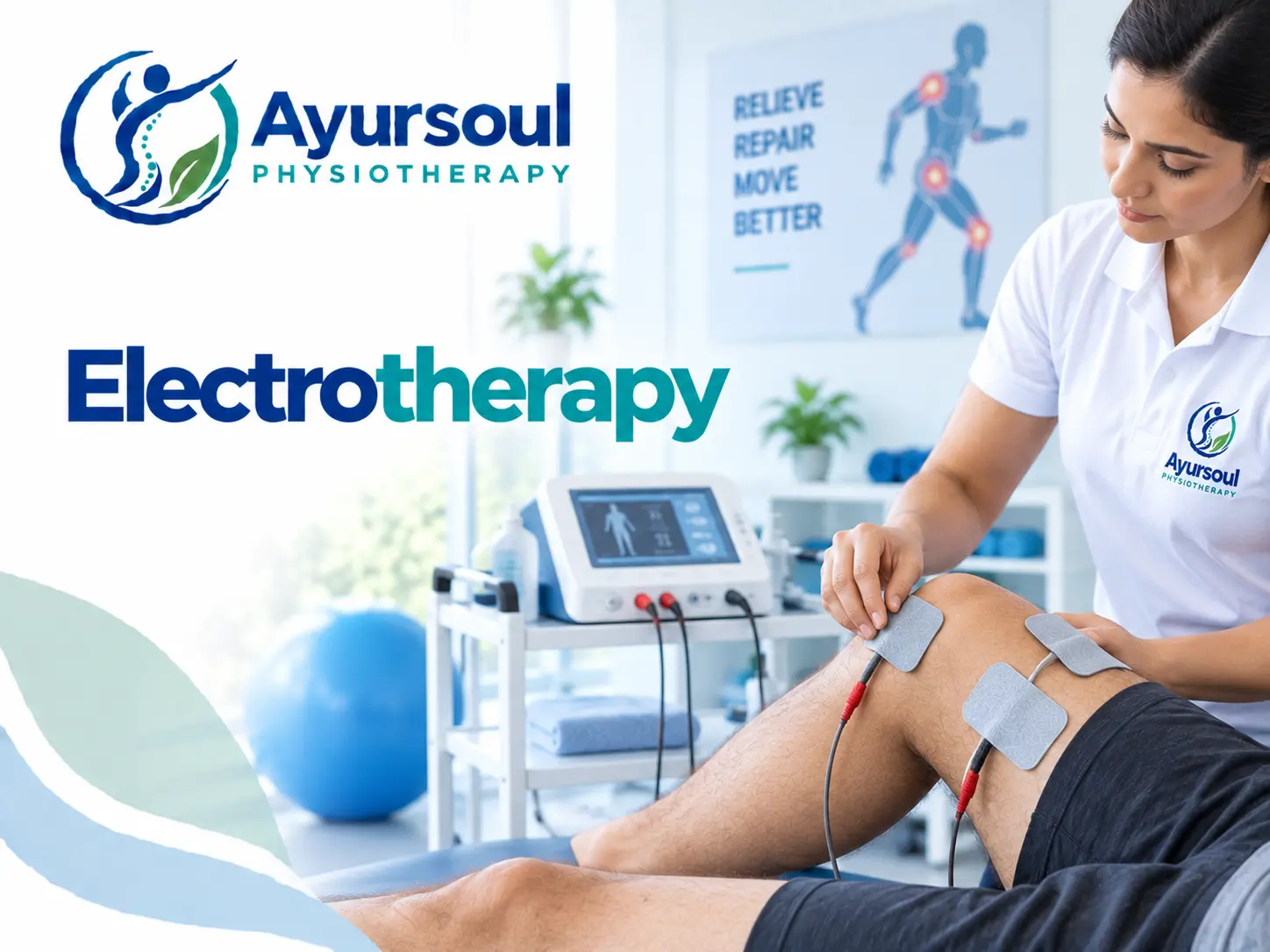
Electrotherapy refers to a group of physiotherapy techniques — such as TENS (transcutaneous electrical nerve stimulation), interferential therapy (IFT), and neuromuscular electrical stimulation (NMES) — that use low-level electrical currents to help with pain, muscle activation, and swelling. It is generally used as one part of a broader physiotherapy plan rather than as a stand-alone fix, and whether it is appropriate for you depends on your specific condition and physiotherapist's assessment.
People are commonly referred for or ask about electrotherapy when they are dealing with muscle pain that isn't settling, a muscle that feels "switched off" or weak after an injury or surgery, ongoing swelling around a joint, or ongoing muscle spasm. It is seen across a wide range of patients — from someone recovering after knee or shoulder surgery, to an athlete managing a soft tissue strain, to someone with a long-standing musculoskeletal condition.
At Ayursoul Physiotherapy in Sector 75, Noida, electrotherapy is one of several modalities that may be used, depending on clinical findings, alongside approaches like manual therapy and guided exercise. In many cases it can support pain modulation and muscle re-education, but it is not presented as a guaranteed or standalone cure — a physiotherapist can advise, after assessment, whether it fits into your recovery plan.

Common Symptoms of Electrotherapy
- Persistent muscle or joint pain that limits daily activity
- A muscle that feels weak or difficult to "switch on" after an injury or surgery
- Localised swelling or puffiness around a joint or muscle
- Muscle spasm or cramping that does not settle with rest
- Reduced ability to activate a muscle fully during exercise, e.g. after knee surgery
- Tingling, numbness, or altered sensation in a limb
- Recovery that has plateaued despite ongoing exercise-based rehabilitation
- Chronic aches or stiffness affecting movement and function
Common Causes & Risk Factors
The symptoms electrotherapy is sometimes used for can have a number of underlying causes, and identifying the actual cause is an important part of deciding whether electrotherapy — or another approach entirely — is appropriate. Common contributing factors include:
- Soft tissue injuries such as muscle strains or ligament sprains
- Post-surgical muscle weakness or muscle "inhibition", for example after knee or shoulder surgery
- Prolonged immobilisation, such as time spent in a cast, splint, or extended bed rest
- Overuse or repetitive strain affecting a muscle or joint
- Degenerative joint conditions, including osteoarthritis
- Nerve irritation or compression contributing to pain or altered sensation
These causes vary a great deal from person to person, and the same symptom can arise from quite different underlying issues. This is why a physiotherapy assessment, rather than self-diagnosis, is generally recommended before starting electrotherapy or any other treatment.
How Physiotherapy Helps
When electrotherapy is considered clinically appropriate, a physiotherapist may use it to support pain modulation, encourage circulation around an injured area, help reduce swelling, or assist in re-educating a muscle that has become weak or underactive after injury or surgery. It is typically introduced as a supporting tool within a wider plan rather than used in isolation, and its role is usually to make other active work — such as exercise and movement retraining — more comfortable or achievable.
Because responses to electrotherapy vary between individuals and conditions, a physiotherapist will generally monitor how you respond over a course of sessions and adjust the overall plan accordingly. In many cases, the longer-term improvement in strength, mobility, and function comes from the exercise and movement components of care, with electrotherapy playing a supportive part where clinically indicated.
What to Expect at Assessment
Before recommending electrotherapy, a physiotherapist will typically start with a detailed history — asking about how and when your symptoms began, any injury or surgery involved, prior treatments, and relevant medical conditions. This is usually followed by a physical assessment of the affected area, looking at movement range, muscle strength and activation, swelling, skin condition, and pain response. The physiotherapist will also check for factors that may make electrotherapy unsuitable, such as certain implanted devices, pregnancy, epilepsy, or skin sensitivity in the area. Based on these findings, they can advise whether electrotherapy may have a role in your care, and how it might fit alongside other treatment approaches.
How Treatment May Be Approached
The exact mix used depends on your assessment — not every technique below applies to every person.
Electrotherapy
Modalities such as TENS, interferential therapy, or NMES may be used, when clinically appropriate, to help with pain modulation, reduce swelling, or support muscle re-education after injury or surgery.
Therapeutic Exercise
Alongside electrotherapy, a tailored exercise programme may be introduced to gradually rebuild movement, control, and function in the affected area.
Strengthening
Once pain and swelling are better managed, progressive strengthening exercises can help restore muscle capacity that may have reduced after injury or a period of inactivity.
Manual Therapy
Hands-on techniques may be used to complement electrotherapy in addressing joint stiffness, soft tissue tightness, or localised pain.
Movement Retraining
For muscles that have become underactive after surgery or prolonged rest, movement retraining can help re-establish normal activation and movement patterns.
Functional Rehabilitation
As symptoms improve, a physiotherapist may guide a gradual, structured return to daily activities, work tasks, or sport-specific movements.
Frequently Asked Questions
What exactly is electrotherapy in physiotherapy?
Electrotherapy is an umbrella term for physiotherapy techniques such as TENS, interferential therapy, and NMES that apply low-level electrical currents to the body, generally to help with pain, muscle activation, or swelling. It is usually used alongside other treatments rather than by itself, depending on your condition.
Does electrotherapy hurt?
Most people describe electrotherapy as a tingling sensation or a mild, involuntary muscle contraction rather than pain, and intensity is generally adjusted to what you find comfortable. If anything feels uncomfortable or too strong during a session, let your physiotherapist know so they can adjust it.
How many electrotherapy sessions will I need?
This varies widely depending on your condition, how you respond to treatment, and what else is included in your plan, so it isn't possible to give a fixed number in advance. Your physiotherapist can give you a clearer sense of an expected course after your initial assessment.
Can electrotherapy be combined with other treatments like manual therapy?
Yes, electrotherapy is often used alongside other approaches such as manual therapy, therapeutic exercise, or other modalities available at the clinic, when this fits your assessment findings. The overall combination is decided based on your specific presentation.
Is electrotherapy safe for everyone?
Electrotherapy isn't suitable for everyone — for example, it is generally avoided in people with certain implanted electronic devices like pacemakers, in pregnancy, over areas of active infection, or with certain skin sensitivities. A physiotherapist will screen for these factors before recommending it.
Can electrotherapy help with long-standing or chronic pain?
In many cases electrotherapy may help support pain management as part of a broader chronic pain plan, but it is not a guaranteed fix and results vary between individuals. It tends to work best combined with an active approach involving exercise and movement.
What kinds of conditions is electrotherapy commonly used for?
It is commonly considered for conditions involving muscle weakness after injury or surgery, ongoing muscle or joint pain, localised swelling, or muscle spasm. Whether it is the right fit for your specific situation depends on assessment by a physiotherapist.
Do I need a doctor's referral to get electrotherapy at Ayursoul Physiotherapy?
You can generally book directly for a physiotherapy assessment without a prior referral. Dr. Ashok K. Anand will assess your condition first to determine whether electrotherapy, or another approach, is appropriate for you.
Clinical Evidence & References
The physiotherapy approaches discussed on this page are informed by published clinical research and evidence-based rehabilitation literature. Selected references are provided below for further reading.
-
Iolascon G, Franchi M, Bernetti A, Galeri S, de Sire A, Picelli A, et al. SIMFER guidelines on physical modalities for chronic primary pain management. Eur J Phys Rehabil Med. 2026;62(3):221-231. PMID: 42262745. DOI: 10.23736/S1973-9087.26.09631-0.
Clinical practice guideline An Italian rehabilitation guideline conditionally supports adding physical modalities such as TENS for fibromyalgia and complex regional pain syndrome, though evidence certainty ranged from moderate to very low.
-
Johnson MI, Paley CA, Jones G, Mulvey MR, Wittkopf PG. Efficacy and safety of transcutaneous electrical nerve stimulation (TENS) for acute and chronic pain in adults: a systematic review and meta-analysis of 381 studies (the meta-TENS study). BMJ Open. 2022;12(2):e051073. PMID: 35144946. DOI: 10.1136/bmjopen-2021-051073.
Systematic review and meta-analysis Pooling 91 placebo-controlled trials, pain was lower during or immediately after TENS than with placebo (moderate-certainty evidence); the review did not show how long relief lasts.
-
Wang JJ, Kang YN, Kvasnička T, Hou WH. Frequencies of transcutaneous electrical nerve stimulation and interferential current for chronic low back pain: a network meta-analysis. Ann Phys Rehabil Med. 2026;69(3):102056. PMID: 41275581. DOI: 10.1016/j.rehab.2025.102056.
Systematic review and meta-analysis Across 15 trials in chronic low back pain, interferential current and high-frequency TENS reduced pain more than control, but low-frequency TENS did not; certainty of evidence was low.
-
Tai D, Kim E, Grover P, Rodriguez A, Olivier TJ, Annaswamy TM. Low-value interventions to deimplement: A secondary analysis of a systematic review of low back pain clinical practice guidelines. PM R. 2025;17 Suppl 2(Suppl 2):S146-S163. PMID: 39444252. DOI: 10.1002/pmrj.13270.
Systematic review A review of 21 low back pain guidelines found TENS was among the treatments most often strongly recommended against for chronic low back pain.
-
Cano-Orihuela M, Aibar-Almazán A, Vico-Rodríguez P, Hita-Contreras F, Castellote-Caballero Y. Noninvasive electrical stimulation on pain and function in knee osteoarthritis in middle-aged and older adults: systematic review and meta-analysis of randomized clinical trials. Front Med (Lausanne). 2026;13:1792432. PMID: 42040599. DOI: 10.3389/fmed.2026.1792432.
Systematic review and meta-analysis In 15 knee osteoarthritis trials, NMES improved quadriceps strength and function, while TENS gave variable results with little benefit beyond short-term pain relief; results varied widely between trials.
-
Zhang S, Wang H, Zhang R, Zhang H, He L. Effects of electrical stimulation on lower limb function after anterior cruciate ligament reconstruction: a systematic review and network meta-analysis. BMC Musculoskelet Disord. 2026;27(1). PMID: 42351029. DOI: 10.1186/s12891-026-10069-8.
Systematic review and meta-analysis In 11 trials after ACL reconstruction, adding electrical stimulation, especially NMES, to rehabilitation reduced pain and improved knee motion, but did not improve overall knee-function scores.
-
Mahnik S, Aljinović A, Mahnik A, Hrabač P, Žabčić M, Bojanić I. Electromyographic biofeedback or neuromuscular electrical stimulation added to isometric quadriceps exercise does not improve pain and functional outcomes in knee osteoarthritis: a randomized controlled trial. Int J Rehabil Res. 2026;49(1):3-10. PMID: 41504515. DOI: 10.1097/MRR.0000000000000689.
Randomized controlled trial In 93 people with knee osteoarthritis, adding NMES or EMG biofeedback to quadriceps exercise gave no extra benefit for pain, function or quality of life over exercise alone.