
Slip Disc Physiotherapy in Noida
Dealing with slip disc pain or sciatica? Ayursoul Physiotherapy in Sector 75, Noida offers assessment-led care to help manage symptoms and improve movement.
Visit Ayursoul Physiotherapy Clinic
Ayursoul Healthcare, Spectrum Mall, Sector 75, Noida, Uttar Pradesh
Open daily: 10:00 AM – 8:00 PM
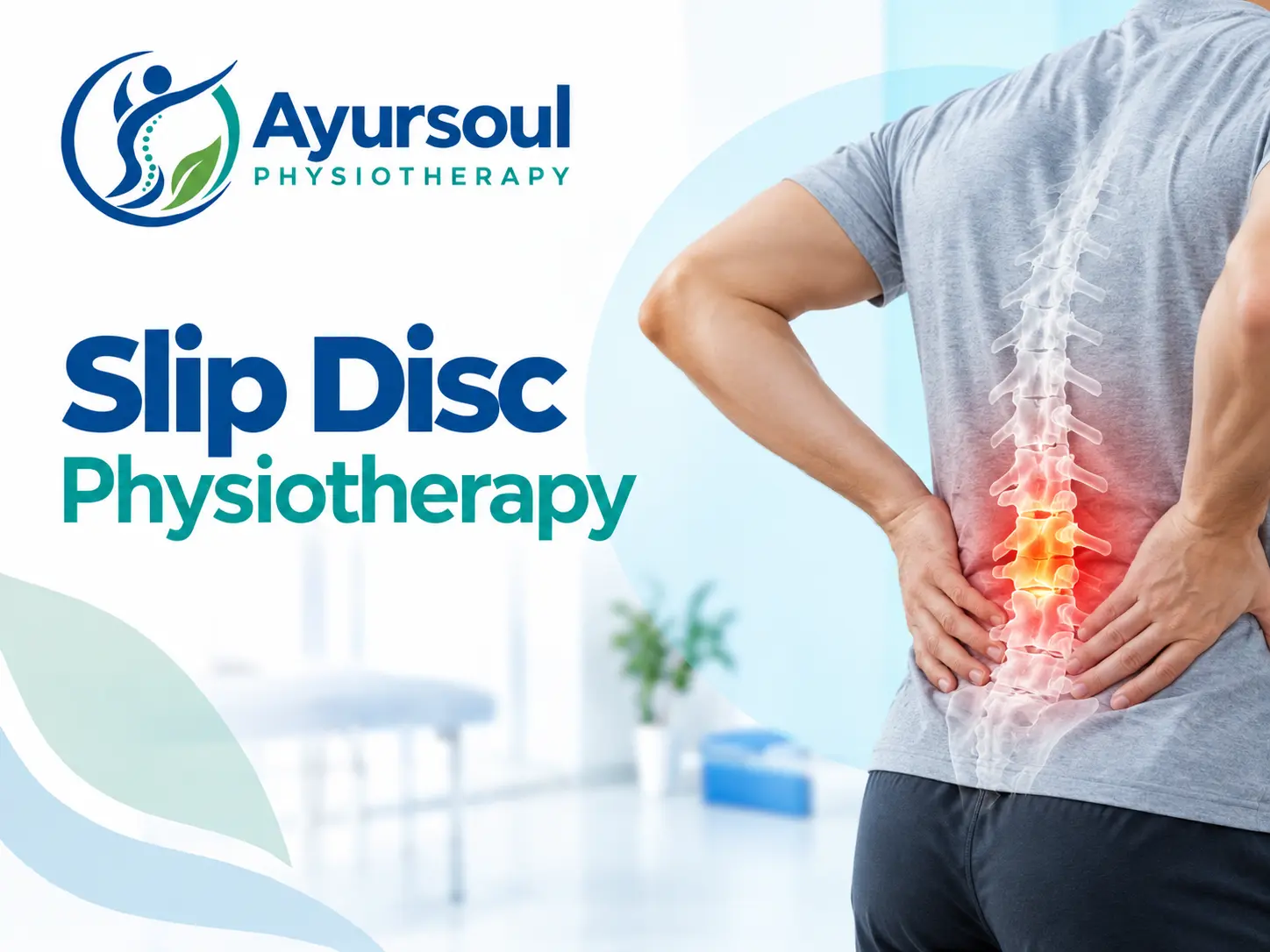
Need Help With Slip Disc (Herniated / Prolapsed Disc)?
If a slip disc is affecting your back or leg comfort, you can reach out to Ayursoul Physiotherapy in Sector 75, Noida to book an assessment and discuss a physiotherapy plan suited to your condition.
A slip disc, also called a herniated or prolapsed disc, occurs when the soft, gel-like cushion between two vertebrae bulges outward or ruptures and presses on nearby nerve tissue. It most commonly affects the lower back (lumbar spine), though it can occur in the neck as well. People often describe it as a deep ache in the back that can radiate into the buttock or leg, sometimes along with tingling, numbness, or a feeling of weakness.
This kind of pain tends to show up in people who do repetitive heavy lifting, sit for long hours at a desk, or have had a sudden twisting injury, though disc changes can also develop gradually with age. At Ayursoul Physiotherapy in Sector 75, Noida (Spectrum Mall), Dr. Ashok K. Anand sees a fair number of patients dealing with slip disc-related back and leg pain, and care generally starts with understanding how the pain behaves before deciding on an approach.
Depending on the severity and stage of the disc issue, physiotherapy may help reduce pain, improve movement, and support the muscles that stabilise the spine. It is not a substitute for medical diagnosis or emergency care, and in some cases it works alongside guidance from your physician, but after a proper assessment it can be a useful part of managing symptoms and getting back to daily activities.
Common Symptoms of Slip Disc (Herniated / Prolapsed Disc)
- Lower back pain that may worsen with sitting, bending, or coughing
- Pain radiating into the buttock, thigh, or down one leg (sciatica-type pain)
- Tingling or a pins-and-needles sensation in the leg or foot
- Numbness in specific areas of the leg or foot
- Muscle weakness in the leg, foot, or toes
- Pain that eases when lying down but worsens with prolonged sitting or standing
- Reduced range of motion or stiffness in the lower back
- Muscle spasm or tightness around the lower back
Common Causes & Risk Factors
A slip disc rarely has just one cause — it's usually a combination of everyday strain and how the spine has changed over time. Discs naturally lose some water content and flexibility with age, which may make them more prone to bulging or tearing under stress.
- Improper lifting technique, especially lifting heavy objects with a bent back
- Prolonged sitting with poor posture, common with desk-based or driving jobs
- Sudden twisting or bending movements
- Age-related disc degeneration and reduced disc hydration
- Carrying extra body weight, which can add load on the lower spine
- A sedentary lifestyle with weaker core and back muscles
- Previous back injury or repetitive strain from certain occupations or sports
Not everyone with these risk factors goes on to develop a slip disc, and the exact cause can vary from person to person, which is why an individual assessment matters more than trying to self-diagnose from a list of risk factors.
How Physiotherapy Helps
When someone comes in with a suspected slip disc, physiotherapy generally focuses on calming irritated nerve tissue and easing muscle guarding first, before moving on to longer-term strength and movement goals. Depending on your presentation, a physiotherapist may recommend a combination of manual therapy, guided exercise, and modalities such as traction therapy to support symptom management when clinically appropriate, though the exact mix depends on assessment findings and how you respond to initial care.
As pain settles, the focus can shift toward restoring more normal movement patterns, gradually building strength in the core and back-supporting muscles, and building awareness of postures or movements that may otherwise aggravate the disc. This staged approach is meant to work alongside the body's own healing process rather than force a fixed timeline, since recovery from a slip disc can vary quite a bit between individuals.
What to Expect at Assessment
An assessment for a suspected slip disc typically starts with a detailed history — when the pain began, what makes it better or worse, whether there is any leg pain, numbness, or weakness, and screening for red-flag symptoms that would need urgent medical attention. This is usually followed by a physical and movement assessment, which may include checking range of motion, posture, gait, and specific neurological tests such as reflexes, sensation, and muscle strength in the legs. Based on these findings, a physiotherapist can build a clearer picture of which movements or positions aggravate your symptoms and use that, together with your goals, to shape a treatment plan going forward.
How Treatment May Be Approached
The exact mix used depends on your assessment — not every technique below applies to every person.
Manual Therapy
Hands-on techniques may be used to help ease muscle tightness and stiffness around the lower back, which can support pain relief in the earlier stages, depending on your assessment.
Mobility Exercises
Gentle mobility work for the spine and hips may be introduced once acute pain has settled, aiming to gradually restore more comfortable movement.
Therapeutic Exercise
A physiotherapist may guide you through specific exercises intended to support the disc's natural healing process, progressed at a pace suited to how your symptoms respond.
Strengthening
Core and back-supporting muscle strengthening can be introduced gradually to help provide better support to the spine, when clinically appropriate.
Posture Education
Guidance on sitting, standing, and lifting posture may be included to help reduce ongoing strain on the affected disc, especially for those with desk-based routines.
Movement Retraining
Retraining everyday movement patterns, such as how you bend or lift, can be part of care and may help lower the chance of repeated strain going forward.
Frequently Asked Questions
Can a slip disc be treated with physiotherapy, or do I need surgery?
Many people with a slip disc are managed with non-surgical care, and physiotherapy is often part of that after a proper assessment. Surgery is generally considered only in specific situations, such as significant nerve involvement or red-flag symptoms, so this is best discussed with your treating doctor.
How long does it take for physiotherapy to help with slip disc pain?
This varies from person to person depending on the severity of the disc issue, how long symptoms have been present, and how the body responds to treatment. Some people notice gradual improvement over a few weeks, while others may take longer, and a physiotherapist can give you a better idea after assessing you.
Is it okay to walk if I have a slip disc?
Light walking is often tolerated and can sometimes help, but this depends on how your symptoms behave with movement. It's best to get assessed so a physiotherapist can advise on activity levels suited to your specific presentation.
Will the pain from a slip disc go away completely?
Physiotherapy may help manage pain and improve function, but outcomes vary and there is no guaranteed timeline or result for every individual. A physiotherapist can help set realistic expectations once they have assessed your specific case.
Should I stay in bed rest if I have a slip disc?
Complete bed rest for long periods generally isn't advised, though a short period of relative rest during a flare-up may be reasonable. Ongoing management usually involves a gradual return to movement and guided exercise, tailored to your assessment.
What's the difference between a slip disc and regular back pain?
Regular back pain doesn't usually involve nerve-related symptoms like leg pain, tingling, or numbness, while slip disc symptoms often do, though not always. A physiotherapist or doctor can help work out which is more likely based on your specific symptoms.
Can I keep exercising or going to the gym with a slip disc?
Some forms of movement may be fine while others may need to be modified or avoided temporarily, depending on what aggravates your symptoms. It's best to get individual guidance rather than continuing your usual routine unchanged.
Do I need an MRI before starting physiotherapy for a slip disc?
Not always — many cases can be assessed clinically first, with imaging usually reserved for situations involving red-flag symptoms, lack of improvement, or when a doctor recommends it. A physiotherapist can advise whether imaging seems necessary based on your assessment.
Clinical Evidence & References
The physiotherapy approaches discussed on this page are informed by published clinical research and evidence-based rehabilitation literature. Selected references are provided below for further reading.
-
Stochkendahl MJ, Kjaer P, Hartvigsen J, Kongsted A, Aaboe J, Andersen M, et al. National Clinical Guidelines for non-surgical treatment of patients with recent onset low back pain or lumbar radiculopathy. Eur Spine J. 2018;27(1):60-75. PMID: 28429142. DOI: 10.1007/s00586-017-5099-2.
Clinical practice guideline For recent-onset back pain or sciatica, Danish guidelines advise staying active and explaining warning signs, then supervised exercise or manual therapy if needed, not routine imaging; evidence was low-to-moderate quality.
-
Wegner I, Widyahening IS, van Tulder MW, Blomberg SE, de Vet HC, Brønfort G, et al. Traction for low-back pain with or without sciatica. Cochrane Database Syst Rev. 2013;2013(8):CD003010. PMID: 23959683. DOI: 10.1002/14651858.CD003010.pub5.
Cochrane review Low- to moderate-quality evidence shows traction, alone or added to physiotherapy, probably makes little or no difference to pain, function or overall improvement in back pain with sciatica.
-
De Bruyn F, Ambaliya S, Depreitere B. Prognostic factors for treatment success of conservative management and role for physiotherapy in radicular pain caused by a lumbar disc herniation: a systematic review. Brain Spine. 2025;5:105870. PMID: 41321762. DOI: 10.1016/j.bas.2025.105870.
Systematic review A review found physiotherapy eased leg pain from a lumbar disc herniation in five of seven studies, while severe symptoms at the start predicted poorer recovery; better-quality trials are needed.
-
Yu P, Mao F, Chen J, Ma X, Dai Y, Liu G, et al. Characteristics and mechanisms of resorption in lumbar disc herniation. Arthritis Res Ther. 2022;24(1):205. PMID: 35999644. DOI: 10.1186/s13075-022-02894-8.
Narrative review A review explains that herniated disc material can shrink on its own without surgery, driven by immune and inflammatory processes, though which herniations will regress is hard to predict.
-
Benson RT, Tavares SP, Robertson SC, Sharp R, Marshall RW. Conservatively treated massive prolapsed discs: a 7-year follow-up. Ann R Coll Surg Engl. 2010;92(2):147-53. PMID: 19887021. DOI: 10.1308/003588410X12518836438840.
Observational study In 37 people with very large disc herniations who were already improving, 83% recovered fully with non-surgical care and only four needed surgery; a small, selected group.