
Meniscus Injury Physiotherapy in Noida
Meniscus tear or injury causing knee pain, swelling or locking? Physiotherapy at Ayursoul in Noida may support recovery. Book an assessment today.
Visit Ayursoul Physiotherapy Clinic
Ayursoul Healthcare, Spectrum Mall, Sector 75, Noida, Uttar Pradesh
Open daily: 10:00 AM – 8:00 PM
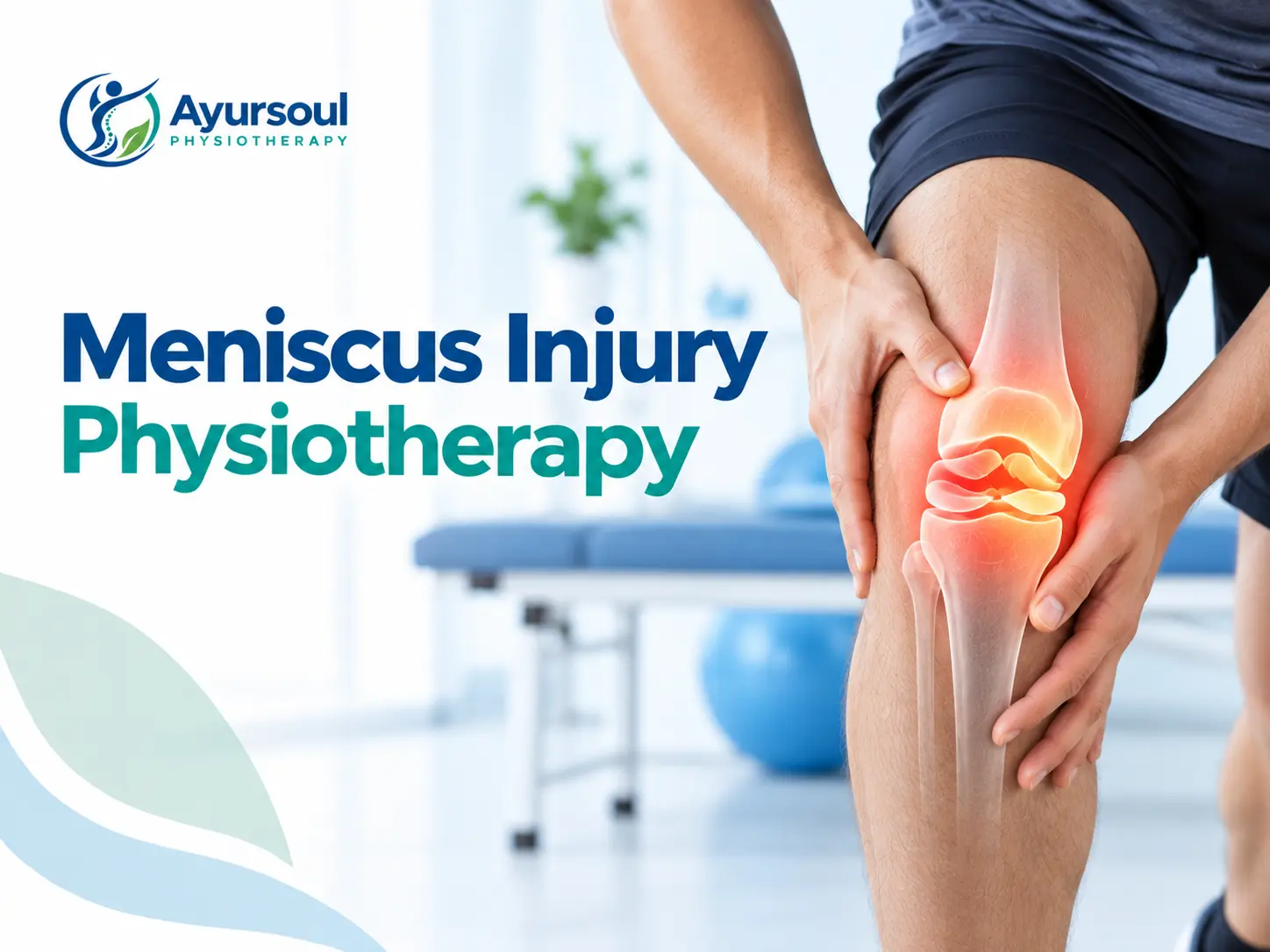
Need Help With Meniscus Injury Physiotherapy?
If you're dealing with knee pain, swelling or a clicking or locking sensation that could be related to a meniscus injury, book a physiotherapy assessment with Dr. Ashok K. Anand (MBBS, CAc, FEA UK) at Ayursoul Physiotherapy, Spectrum Mall, Sector 75, Noida, by calling +91 88003 68078.
The meniscus is a C-shaped piece of cartilage that cushions and stabilises the knee joint. A tear or injury to this tissue can happen suddenly, such as during a twisting movement while playing sport, or it may develop gradually as part of age-related wear affecting the knee. Meniscus injuries are common in athletes who pivot or change direction quickly, but they are also frequently seen in older adults where the tissue has become thinner and more brittle over time.
Not every meniscus injury looks the same, and the right approach depends on factors like the location and pattern of the tear, the person's age and activity level, and whether other knee structures are also affected. Some smaller or degenerative tears may respond well to a structured physiotherapy programme, while others may need to be evaluated by an orthopaedic specialist alongside physiotherapy input.
At Ayursoul Physiotherapy in Noida, physiotherapy for a meniscus injury generally focuses on reducing pain and swelling, restoring knee movement, and rebuilding the strength and control around the joint. This is a general guide to help you understand the condition better — it is not a substitute for an in-person clinical assessment, and it does not diagnose your specific knee problem.

Common Symptoms of Meniscus Injury Physiotherapy
- Pain along the joint line of the knee, often more noticeable on one side
- Swelling that develops within a few hours to a day after a twisting injury
- A clicking, catching or locking sensation when bending or straightening the knee
- Difficulty fully straightening or fully bending the affected knee
- A feeling of the knee "giving way" or feeling unstable during walking or sport
- Stiffness in the knee, particularly after sitting for a while or on first waking
- Tenderness when pressing along the inner or outer joint line
- Reduced ability to squat, kneel, twist or pivot on the affected leg
Common Causes & Risk Factors
Meniscus injuries can occur from a single traumatic event or build up gradually through repeated stress on the knee. Common causes and risk factors include:
- A sudden twisting or pivoting movement with the foot planted, such as during football, badminton or other pivoting sports
- Deep squatting or kneeling combined with rotation of the knee
- Direct impact or a heavy landing that forces the knee into an awkward position
- Age-related degeneration, where the meniscus tissue naturally becomes thinner and less resilient over time
- Occupations or hobbies involving frequent kneeling, squatting or climbing
- A combined injury alongside ligament strain, such as when the knee is twisted forcefully during a fall
- Pre-existing knee joint changes, including early osteoarthritis, which can make the meniscus more prone to tearing
- Excess body weight, which may increase load through the knee joint over time
The exact cause and contributing factors can vary from person to person, which is why an individual assessment is important before starting any treatment plan.
How Physiotherapy Helps
Physiotherapy for a meniscus injury generally aims to calm pain and swelling in the early stages, then gradually restore knee range of motion, strength and stability as symptoms allow. Manual therapy may be used to help ease stiffness around the joint and surrounding soft tissue, while modalities such as ultrasound therapy, laser therapy or electrotherapy may be used alongside exercise as part of a broader pain-management approach, when clinically appropriate. Myofascial release and trigger point therapy may also be considered where surrounding muscle tightness is contributing to discomfort.
As symptoms settle, a physiotherapist may progress the programme to include targeted quadriceps and hamstring strengthening, balance and proprioception work, and functional movement retraining to help support the knee during daily activities or a gradual return to sport. Kinesio taping may be used during this phase to provide additional support during exercise, and an ergonomic assessment may be helpful for those whose work involves repeated kneeling or squatting. The specific combination and pace of treatment is tailored to the individual and may look different depending on whether the meniscus injury is being managed conservatively or alongside surgical input.
What to Expect at Assessment
A physiotherapy assessment for a suspected meniscus injury typically begins with a discussion of how the injury occurred, the pattern and location of symptoms, and any prior knee problems or imaging reports if available. The physiotherapist will usually observe how you walk and move, check the knee's range of motion, and gently examine the joint line for tenderness. Specific clinical tests may be used to help build a picture of which knee structures could be involved, and strength, balance and functional movements such as squatting or step-downs may also be assessed. This information is used to guide a tailored plan and to help identify whether onward referral for imaging or an orthopaedic opinion may be appropriate.
How Treatment May Be Approached
The exact mix used depends on your assessment — not every technique below applies to every person.
Manual Therapy
Hands-on joint mobilisation and soft tissue techniques may be used to help ease stiffness and improve comfortable movement at the knee, when clinically appropriate.
Targeted Strengthening Exercises
Progressive exercises for the quadriceps, hamstrings and hip muscles may be introduced to help support and stabilise the knee joint as symptoms allow.
Range-of-Motion & Flexibility Work
Gentle stretching and mobility exercises may be used to help gradually restore comfortable bending and straightening of the knee.
Electrotherapy, Ultrasound & Laser Therapy
These modalities may be used alongside exercise to help manage localised pain and swelling, particularly in the earlier stages, when clinically appropriate.
Balance & Proprioception Training
Exercises to help retrain knee stability and control may be introduced, particularly where a sense of the knee "giving way" is reported.
Kinesio Taping
May be used to provide additional support and feedback to the knee during exercise or day-to-day activity, when considered suitable.
Frequently Asked Questions
Can a torn meniscus heal without surgery?
Some meniscus tears, particularly smaller or degenerative ones in the outer, better-blood-supplied part of the cartilage, may settle with a structured physiotherapy programme. Others, especially larger tears or those causing persistent locking, may need an orthopaedic opinion. This can only be determined through a proper clinical assessment and, where needed, imaging.
How long does physiotherapy for a meniscus injury usually take?
Recovery timelines vary widely depending on the size and type of tear, your activity level and how your body responds to treatment. A physiotherapist can give you a more individual estimate once your knee has been assessed.
Is it safe to keep walking or exercising with a meniscus injury?
This depends on the severity of your symptoms. Some gentle movement may be encouraged, while high-impact activity is often best avoided until you have been assessed. A physiotherapist can advise on which activities are appropriate for your specific situation.
What is the difference between a meniscus tear and general knee pain?
General knee pain can have many causes, while a meniscus tear refers specifically to damage to the cartilage cushioning the joint, often with associated clicking, catching or locking. If your symptoms don't clearly point to a meniscus problem, our knee pain physiotherapy page may be more relevant, and an assessment can help clarify the underlying cause.
Can a meniscus tear happen alongside a ligament injury?
Yes, meniscus tears can occur together with ligament injuries, particularly after a forceful twisting injury to the knee. If a combined injury is suspected, assessment and management may need to address both structures.
Will I need an MRI scan for a suspected meniscus tear?
Not always. Many meniscus-related symptoms can be initially managed based on a clinical assessment, but imaging may be recommended in certain cases, particularly if symptoms are severe, persistent or if surgery is being considered. This is a decision made in consultation with a doctor or specialist.
What exercises should I avoid with a meniscus injury?
Deep squatting, pivoting movements and high-impact activities are often best limited or modified until your knee has been properly assessed, as these movements place extra load through the meniscus. A physiotherapist can guide you on safe modifications.
Can physiotherapy help after meniscus surgery?
Yes, physiotherapy is commonly used to support recovery after a meniscus repair or partial meniscectomy. This follows a different, phased rehabilitation approach guided by your surgeon's protocol and is addressed separately from general meniscus injury management.
Clinical Evidence & References
The physiotherapy approaches discussed on this page are informed by published clinical research and evidence-based rehabilitation literature. Selected references are provided below for further reading.
-
Prill R, Ma CB, Wong SE, Beaufils P, Monllau JC, Arhos EK, et al. The formal EU-US Meniscus Rehabilitation 2024 Consensus: An ESSKA-AOSSM-AASPT initiative. Part II-Prevention, non-operative treatment and return to sport. Knee Surg Sports Traumatol Arthrosc. 2025;33(8):3014-3024. PMID: 40501314. DOI: 10.1002/ksa.12689.
Consensus statement International expert consensus states non-operative physical therapy is the first-line approach for degenerative meniscus lesions and may suit some acute tears, though evidence quality is low to moderate.
-
O'Connor D, Johnston RV, Brignardello-Petersen R, Poolman RW, Cyril S, Vandvik PO, et al. Arthroscopic surgery for degenerative knee disease (osteoarthritis including degenerative meniscal tears). Cochrane Database Syst Rev. 2022;3(3):CD014328. PMID: 35238404. DOI: 10.1002/14651858.CD014328.
Cochrane review In degenerative knee disease including meniscal tears, high-certainty evidence shows arthroscopic surgery gives little or no pain or function benefit over placebo surgery at three months.
-
Kise NJ, Risberg MA, Stensrud S, Ranstam J, Engebretsen L, Roos EM. Exercise therapy versus arthroscopic partial meniscectomy for degenerative meniscal tear in middle aged patients: randomised controlled trial with two year follow-up. BMJ. 2016;354:i3740. PMID: 27440192. DOI: 10.1136/bmj.i3740.
Randomized controlled trial In 140 middle-aged patients with degenerative meniscal tears, 12 weeks of supervised exercise matched arthroscopic meniscectomy at 2 years and improved thigh strength more in the short term.
-
Katz JN, Brophy RH, Chaisson CE, de Chaves L, Cole BJ, Dahm DL, et al. Surgery versus physical therapy for a meniscal tear and osteoarthritis. N Engl J Med. 2013;368(18):1675-84. PMID: 23506518. DOI: 10.1056/NEJMoa1301408.
Randomized controlled trial In 351 patients with a meniscal tear and mild-to-moderate osteoarthritis, physical therapy matched surgery for functional improvement at 6 months, though 30% had crossed over to surgery.