
Balance & Coordination Training in Noida
Balance or coordination trouble affecting daily activities? Ayursoul Physiotherapy in Sector 75, Noida offers assessment-led training for better stability.
Visit Ayursoul Physiotherapy Clinic
Ayursoul Healthcare, Spectrum Mall, Sector 75, Noida, Uttar Pradesh
Open daily: 10:00 AM – 8:00 PM
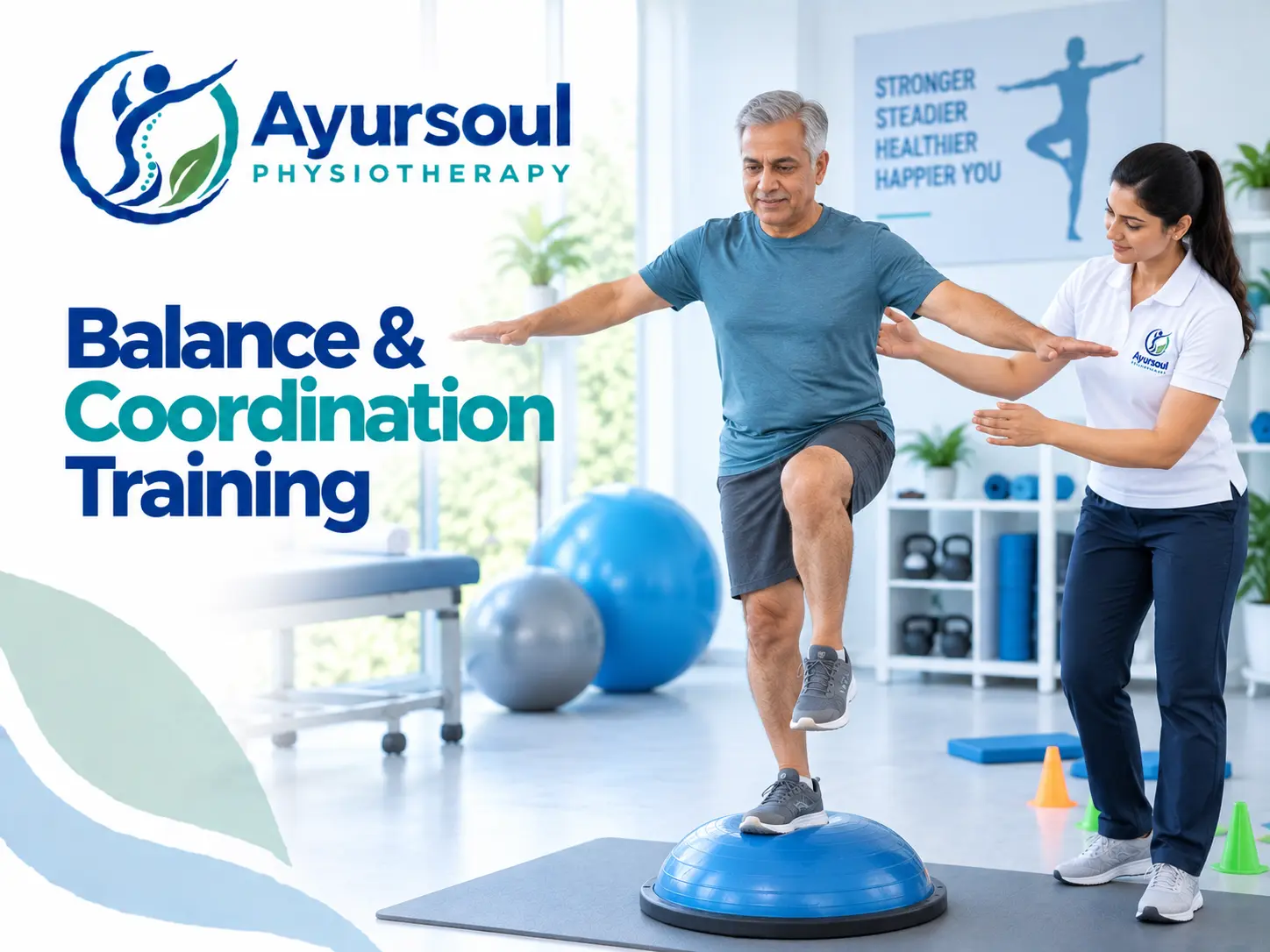
Need Help With Balance & Coordination Training?
If balance or coordination changes have been affecting your confidence in daily movement, you're welcome to book an assessment with Dr. Ashok K. Anand at Ayursoul Physiotherapy in Sector 75, Noida, to discuss whether a tailored balance training programme may help.
Balance and coordination training is a structured physiotherapy approach aimed at helping people who feel unsteady on their feet, stumble more often than they used to, or have noticed their movements have become less coordinated. This can show up as difficulty walking on uneven ground, hesitation on stairs, or a general sense of not trusting one's own footing anymore. It is a common concern among older adults, but it can also affect younger people recovering from an injury, a neurological event, or a period of reduced activity.
People experiencing balance or coordination changes often describe a mix of physical and emotional effects — occasional near-falls, a slower and more cautious walking pattern, or simply avoiding activities they used to enjoy out of fear of falling. The underlying reasons can vary widely, from inner-ear issues to muscle weakness to neurological conditions, which is why a proper assessment matters before starting any exercise programme.
At Ayursoul Physiotherapy, located in Spectrum Mall, Sector 75, Noida, a physiotherapy assessment can help identify which factors may be contributing to a person's balance difficulty, and a plan can then be built around those findings. Depending on the assessment, this may involve targeted balance retraining, strengthening, and functional exercises — always tailored to the individual, since not every person with balance concerns needs the same treatment.

Common Symptoms of Balance & Coordination Training
- Feeling unsteady or off-balance while standing or walking
- Frequent stumbling, tripping, or near-falls
- Difficulty walking on uneven surfaces, in the dark, or on stairs
- A sensation of dizziness, lightheadedness, or the room spinning
- Needing to hold onto furniture, walls, or another person for support
- A slower, more cautious, or wider-based walking pattern than before
- Difficulty standing on one leg, turning quickly, or changing direction
- Reduced confidence in crowded places or open, unsupported spaces
Common Causes & Risk Factors
Balance and coordination difficulties can arise from a number of different sources, and often more than one factor is involved at the same time. Age-related changes to muscle strength, joint flexibility, and the sensory systems that help control balance are common contributors, but balance concerns are not limited to older adults.
- Inner-ear or vestibular system disturbances affecting the sense of spatial orientation
- Neurological conditions such as stroke, Parkinson's disease, or peripheral neuropathy
- General muscle weakness, particularly in the legs, hips, and core
- Reduced joint mobility or previous injuries affecting movement patterns
- Vision changes that reduce the reliability of visual balance cues
- A previous fall, which can itself lead to reduced confidence and altered movement
- Certain medications that may cause dizziness or affect alertness
- Extended periods of inactivity or bed rest, which can decondition the balance system
Because the possible causes are so varied, a physiotherapist typically asks about medical history and recent changes before recommending an exercise-based approach, and may suggest referral for further medical evaluation when appropriate.
How Physiotherapy Helps
Physiotherapy for balance and coordination generally focuses on retraining the body's ability to sense position and movement, respond to changes in surface or direction, and recover from a stumble before it becomes a fall. After assessment, a physiotherapist may recommend a programme combining balance-specific drills, strengthening for the legs and core, and gait retraining, progressed gradually as confidence and stability improve.
In many cases, this approach can also involve education on practical strategies for safer movement at home and outdoors, since day-to-day habits play a role alongside formal exercise. The goal of physiotherapy in this context is not to guarantee that falls will never occur, but to support the underlying strength, coordination, and confidence that can make everyday movement feel more secure over time, when clinically appropriate for the individual.
What to Expect at Assessment
An assessment for balance or coordination concerns generally begins with a detailed history, including when the difficulty started, any recent falls or near-falls, relevant medical conditions, and medications. The physiotherapist may then observe walking pattern and posture, check muscle strength and joint range of motion in the legs and trunk, and use simple functional balance tasks such as standing on one leg or standing with eyes closed to understand where the main challenges lie. Depending on the findings, further evaluation of the vestibular or neurological system, or referral to another healthcare provider, may be recommended before an exercise programme is finalised.
How Treatment May Be Approached
The exact mix used depends on your assessment — not every technique below applies to every person.
Balance Training
Structured exercises that progressively challenge standing and walking balance may be included, often starting on a stable surface and advancing to more demanding conditions as tolerated.
Therapeutic Exercise
A general exercise programme may be recommended to support overall fitness, coordination, and confidence in movement, tailored to the person's current ability.
Strengthening
Strengthening exercises for the legs, hips, and core can be included, since adequate muscle strength is often needed to support stability during daily activities.
Movement Retraining
Gait and movement retraining may focus on walking pattern, step length, and turning strategies to help make everyday walking feel more controlled.
Functional Rehabilitation
Exercises may be adapted to reflect real-life tasks, such as getting up from a chair, navigating stairs, or walking while carrying an object, depending on individual goals.
Manual Therapy
When joint stiffness or muscle tightness appears to be contributing to altered movement, manual therapy techniques may be used alongside exercise, depending on assessment findings.
Posture Education
Guidance on posture and body alignment during standing and walking may be provided to support more efficient and stable movement patterns.
Frequently Asked Questions
Can physiotherapy actually help with balance problems?
For many people, physiotherapy can help by targeting the strength, coordination, and movement patterns that contribute to balance difficulty, though results depend on the underlying cause and individual assessment. It is not a guaranteed fix for every case, and some causes may need additional medical evaluation alongside physiotherapy.
Is balance training only for elderly people?
No, while balance concerns are common with ageing, younger people recovering from an injury, surgery, or a period of inactivity can also benefit from balance and coordination-focused physiotherapy after assessment.
I sometimes feel dizzy when I stand up quickly — is that related?
Dizziness on standing can have several possible causes, including blood pressure changes, medication effects, or inner-ear issues, and it is not always the same as a balance or coordination problem. A physiotherapist can help assess movement-related factors, but this symptom may also need evaluation by a physician.
How many sessions are usually needed for balance training?
The number of sessions varies from person to person depending on the cause, severity, and how the body responds to exercise, so this is best discussed after an initial assessment rather than estimated in advance.
Can balance exercises be done safely at home?
Some exercises may be suitable for home practice once a physiotherapist has assessed the person and taught the correct technique and safety precautions, particularly around fall risk. Starting a balance programme without guidance is generally not advised if falls have already occurred.
Will balance training prevent me from ever falling again?
No physiotherapy programme can guarantee that falls will never happen, but a supervised balance and strengthening programme may help reduce certain risk factors and support more confident movement over time.
Do I need a doctor's referral before starting balance physiotherapy?
A referral is not always required, but if red-flag symptoms such as sudden severe dizziness, weakness, or neurological changes are present, medical evaluation is recommended first, and the physiotherapist may suggest this during assessment.
What should I bring to my first balance assessment?
It can help to bring a list of current medications, details of any recent falls, and information about relevant medical conditions, along with comfortable clothing and footwear suitable for a short movement assessment.
Clinical Evidence & References
The physiotherapy approaches discussed on this page are informed by published clinical research and evidence-based rehabilitation literature. Selected references are provided below for further reading.
-
Sherrington C, Fairhall NJ, Wallbank GK, Tiedemann A, Michaleff ZA, Howard K, et al. Exercise for preventing falls in older people living in the community. Cochrane Database Syst Rev. 2019;1(1):CD012424. PMID: 30703272. DOI: 10.1002/14651858.CD012424.pub2.
Cochrane review A Cochrane review of 108 trials found balance and functional exercise cut the rate of falls by about 24% in community-dwelling people aged 60+ (high-certainty evidence).
-
McDonnell MN, Hillier SL. Vestibular rehabilitation for unilateral peripheral vestibular dysfunction. Cochrane Database Syst Rev. 2015;1(1):CD005397. PMID: 25581507. DOI: 10.1002/14651858.CD005397.pub4.
Cochrane review A Cochrane review of 39 trials found moderate-to-strong evidence that vestibular exercises reduce dizziness in one-sided inner-ear disorders; for BPPV, repositioning manoeuvres work better short term.
-
Chen S, Chen P, Huang L, Guo W, Zhong Y. Dose-response relationships of sensorimotor-based interventions on balance performance in older adults: A systematic review and meta-regression analysis. PLoS One. 2026;21(7):e0354522. PMID: 42490619. DOI: 10.1371/journal.pone.0354522.
Systematic review and meta-analysis Across 24 trials in older adults, sensorimotor balance training improved balance test scores (low- to high-certainty evidence), though dynamic-balance gains may level off at higher cumulative doses.
-
Zhang W, Zhang W, Zu G, Yao M, Li J, Jin Y, et al. Effects of task-oriented training on balance, gait, and fall in older adults: A systematic review and meta-analysis of randomized controlled trials. Aging Clin Exp Res. 2026;38(1):56. PMID: 41566097. DOI: 10.1007/s40520-025-03303-1.
Systematic review and meta-analysis In 20 trials of adults 60+, task-oriented functional training improved balance and gait speed more than conventional exercise, but effects on falls and fear of falling remain unproven.