
Joint Stiffness Treatment in Noida
Struggling with stiff, restricted joints in Noida? Ayursoul Physiotherapy offers assessment-led joint stiffness treatment to help restore comfortable movement.
Visit Ayursoul Physiotherapy Clinic
Ayursoul Healthcare, Spectrum Mall, Sector 75, Noida, Uttar Pradesh
Open daily: 10:00 AM – 8:00 PM
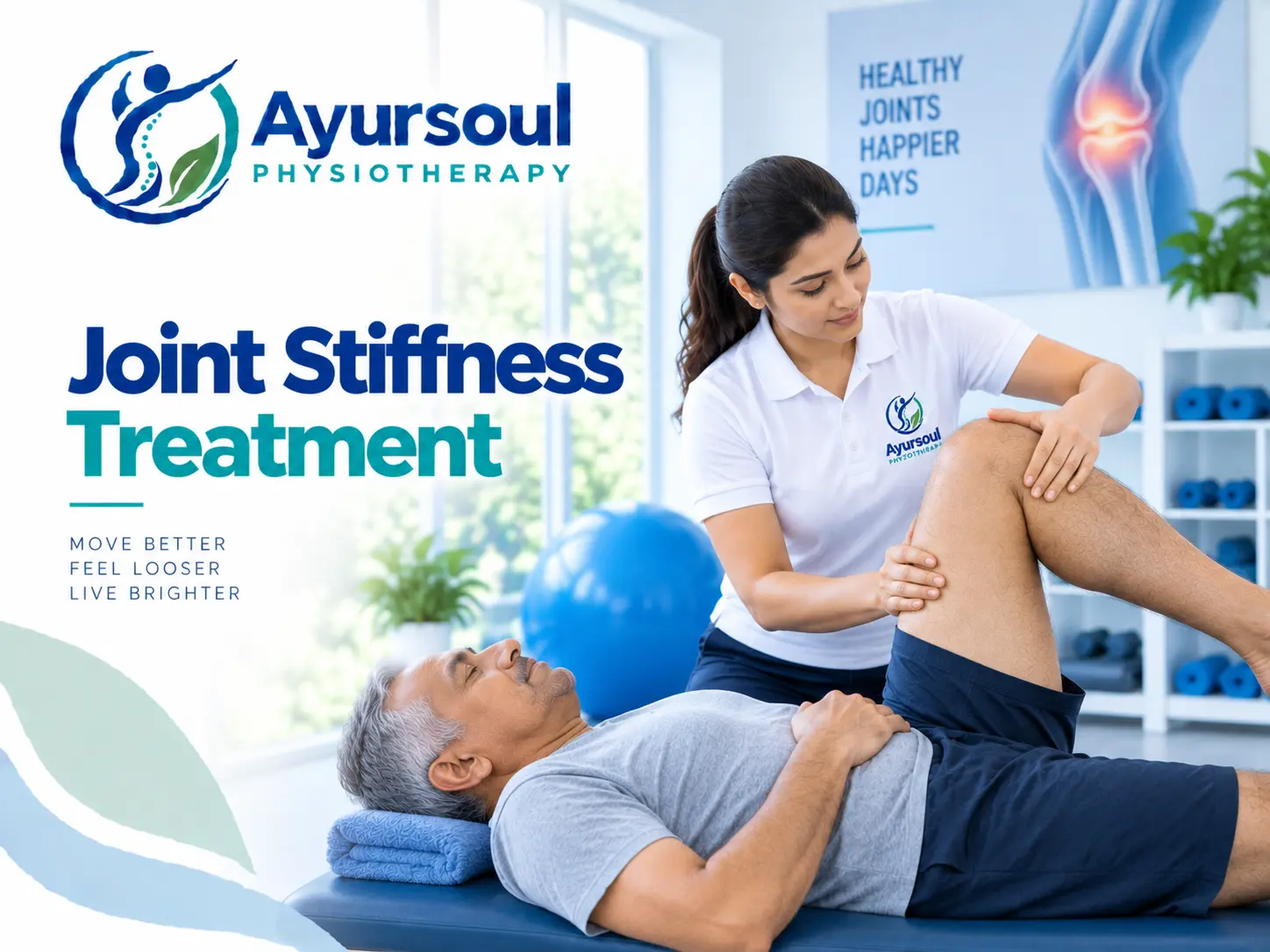
Need Help With Joint Stiffness Treatment?
If joint stiffness is limiting your everyday movement, you can book an assessment with Dr. Ashok K. Anand at Ayursoul Physiotherapy in Spectrum Mall, Sector 75, Noida to discuss a plan suited to your condition.
Joint stiffness is the feeling of tightness, restriction, or difficulty moving a joint smoothly through its normal range. It can affect a single joint, such as a knee or shoulder, or several joints at once, and it often shows up most noticeably after periods of rest, first thing in the morning, or after sitting still for a long stretch. For some people it is a passing nuisance; for others it gradually limits everyday activities like climbing stairs, kneeling, reaching overhead, or simply getting comfortable at a desk.
Joint stiffness is common in adults recovering from an injury or surgery, people with early or established osteoarthritis, those with inflammatory joint conditions, and individuals who spend long hours sitting with limited movement. Age-related changes in the joints, previous sprains or fractures, and periods of prolonged inactivity can all play a role, and often more than one factor is involved at the same time.
At Ayursoul Physiotherapy in Sector 75, Noida, Dr. Ashok K. Anand sees patients from across the city who come in with stiffness that has built up gradually or followed a specific injury. Depending on your condition and after a proper assessment, physiotherapy may help improve joint mobility, reduce associated discomfort, and support a return to easier movement, though the right approach varies from person to person and results are never guaranteed.

Common Symptoms of Joint Stiffness Treatment
- Difficulty moving a joint through its full range, especially first thing in the morning
- A tight, restricted, or "stuck" feeling in one or more joints
- Stiffness that eases somewhat once you start moving but returns after rest
- Discomfort or a dull ache when initiating movement after sitting or lying down
- Increased stiffness after prolonged sitting, driving, or long periods of inactivity
- A sense of tightness or mild swelling around the affected joint
- Reduced ability to fully bend, straighten, or rotate the joint compared to before
- Everyday tasks like climbing stairs, kneeling, gripping, or standing up from a chair feeling harder than usual
Common Causes & Risk Factors
Joint stiffness rarely has a single cause, and the right explanation for one person may not apply to another. In many cases it develops from a combination of factors related to joint health, activity levels, and healing after injury.
- Osteoarthritis or age-related wear on the joint surfaces and cartilage
- Inflammatory joint conditions such as rheumatoid arthritis
- Stiffness following a joint or soft tissue injury, sprain, or fracture
- Stiffness that develops after surgery or a period of immobilisation (such as a cast or splint)
- Prolonged sitting, sedentary desk work, or long periods without movement
- Tightness in the muscles, tendons, or connective tissue surrounding the joint
- Previous joint injuries that were not fully rehabilitated
- Poor posture or repetitive strain patterns that affect joint mechanics over time
Because these causes can overlap, and because stiffness sometimes points to an underlying joint condition that needs medical management, a proper assessment is generally recommended before assuming the cause, particularly if stiffness is persistent or worsening.
How Physiotherapy Helps
Physiotherapy for joint stiffness generally focuses on gradually restoring comfortable movement rather than forcing a joint through pain. Depending on your condition and after assessment, a physiotherapist may use a combination of hands-on techniques and guided exercise to help address restricted movement, tightness in the surrounding soft tissue, and any compensatory patterns that have developed as a result of avoiding movement.
The approach used can vary considerably depending on whether the stiffness follows an injury, relates to osteoarthritis, or has built up gradually from inactivity. In many cases, a physiotherapist may recommend a mix of manual therapy, targeted mobility work, and a structured home exercise programme, adjusting the plan as your movement and comfort levels change over the course of treatment. Physiotherapy is not a substitute for medical management of underlying joint disease, and it is typically used alongside, not instead of, any care your doctor has advised.
What to Expect at Assessment
An assessment for joint stiffness typically starts with a discussion of your history, including when the stiffness began, which joints are involved, what makes it better or worse, and any relevant past injuries, surgeries, or diagnosed conditions. The physiotherapist will usually then examine the affected joint's active and passive range of motion, check surrounding muscle strength and flexibility, and observe how the stiffness affects functional movements such as walking, squatting, or reaching, depending on which joint is involved. This is used to build a working picture of possible contributing factors and to shape a treatment plan appropriate to your presentation, rather than applying a one-size-fits-all protocol.
How Treatment May Be Approached
The exact mix used depends on your assessment — not every technique below applies to every person.
Manual Therapy
Hands-on techniques may be used to help ease tightness around the joint and encourage smoother movement, depending on what the assessment finds.
Mobility Exercises
Guided joint mobility work can be introduced gradually to help restore range of motion at a pace that suits your comfort level.
Stretching
Targeted stretching of the muscles and tissue around a stiff joint may help reduce tightness when included as part of a broader programme.
Strengthening
Once movement improves, strengthening exercises for the muscles supporting the joint may be added to help support long-term joint function.
Therapeutic Exercise
A structured exercise programme, often continued at home, can support gradual progress between in-clinic sessions.
Posture Education
For stiffness linked to prolonged sitting or repetitive positioning, guidance on posture and movement habits may be provided where relevant.
Electrotherapy
Modalities such as ultrasound or laser therapy may be used in some cases to support the broader treatment plan, depending on clinical appropriateness.
Frequently Asked Questions
Why are my joints so stiff in the morning?
Morning joint stiffness is common and can relate to reduced overnight movement, fluid changes around the joint, or, in some cases, an underlying joint condition such as osteoarthritis or inflammatory arthritis. If it regularly lasts more than 30-60 minutes or affects multiple joints, it is worth getting assessed rather than assuming the cause.
Can physiotherapy actually help stiffness from arthritis?
Physiotherapy may help support joint mobility and function in many people with arthritis-related stiffness, depending on the type and stage of arthritis and after a proper assessment. It works alongside, not instead of, any medical treatment your doctor has recommended.
How many sessions will I need for joint stiffness?
This varies significantly from person to person depending on the cause, duration, and severity of the stiffness. Your physiotherapist can give you a more specific idea after your initial assessment, and the plan may be adjusted as your progress is reviewed.
Is joint stiffness the same thing as joint pain?
Not always. Stiffness refers to restricted or difficult movement, while pain is a separate sensation, though the two often occur together. Some people experience stiffness with little pain, and others experience pain without much stiffness.
Can I just do stretches at home instead of seeing a physiotherapist?
Gentle home movement can be a reasonable starting point for mild, short-lived stiffness, but a physiotherapist can help identify what is actually contributing to your stiffness and tailor exercises accordingly, which may be more effective than generic stretches, especially if stiffness persists or affects a specific joint.
Does cold weather make joint stiffness worse?
Many people report that their joints feel stiffer in colder weather, though the exact reasons are not fully settled and can vary between individuals. If this is a pattern for you, it's worth mentioning during your assessment.
When should I stop trying home remedies and get it checked?
If stiffness is persistent, worsening, affecting your daily activities, or accompanied by swelling, redness, fever, weakness, or numbness, it is best to get a professional assessment rather than continuing with home measures alone.
What treatments does Ayursoul Physiotherapy use for joint stiffness?
Depending on your assessment, treatment may draw on manual therapy, guided mobility and stretching exercises, strengthening work, posture guidance, and electrotherapy modalities such as ultrasound or laser therapy where clinically appropriate.
Clinical Evidence & References
The physiotherapy approaches discussed on this page are informed by published clinical research and evidence-based rehabilitation literature. Selected references are provided below for further reading.
-
McAlindon TE, Bannuru RR, Sullivan MC, Arden NK, Berenbaum F, Bierma-Zeinstra SM, et al. OARSI guidelines for the non-surgical management of knee osteoarthritis. Osteoarthritis Cartilage. 2014;22(3):363-88. PMID: 24462672. DOI: 10.1016/j.joca.2014.01.003.
Clinical practice guideline Expert-consensus guideline for knee osteoarthritis rates exercise, strength training and self-management as appropriate for all, ultrasound and TENS as uncertain, and neuromuscular electrical stimulation as not appropriate.
-
Kolasinski SL, Neogi T, Hochberg MC, Oatis C, Guyatt G, Block J, et al. 2019 American College of Rheumatology/Arthritis Foundation Guideline for the Management of Osteoarthritis of the Hand, Hip, and Knee. Arthritis Rheumatol. 2020;72(2):220-233. PMID: 31908163. DOI: 10.1002/art.41142.
Clinical practice guideline US rheumatology guideline strongly recommends exercise and self-management programmes for hand, hip and knee osteoarthritis; balance exercise, acupuncture and thermal modalities receive only conditional recommendations.
-
Harvey LA, Katalinic OM, Herbert RD, Moseley AM, Lannin NA, Schurr K. Stretch for the treatment and prevention of contractures. Cochrane Database Syst Rev. 2017;1(1):CD007455. PMID: 28146605. DOI: 10.1002/14651858.CD007455.pub3.
Cochrane review In 49 trials of people with or at risk of joint contractures, stretching gave no clinically important short-term improvement in joint mobility or, in non-neurological conditions, pain (high-quality evidence).
-
Schleimer T, Teichert F, Henriksen M, Doeding R, Innocenti T, Brisby H, et al. Effectiveness of exercise therapy for osteoarthritis: an overview of systematic reviews and randomised controlled trials. RMD Open. 2026;12(1). PMID: 41702669. DOI: 10.1136/rmdopen-2025-006275.
Systematic review and meta-analysis Overview found small pain benefits from exercise for knee (short-term, very low certainty) and hand osteoarthritis, negligible benefit for hip, and outcomes comparable to education, manual therapy or painkillers.