
Knee Rehabilitation in Noida
Knee surgery, injury, or arthritis recovery? Ayursoul Physiotherapy, Sector 75, Noida offers assessment-led knee rehabilitation to rebuild strength & movement.
Visit Ayursoul Physiotherapy Clinic
Ayursoul Healthcare, Spectrum Mall, Sector 75, Noida, Uttar Pradesh
Open daily: 10:00 AM – 8:00 PM
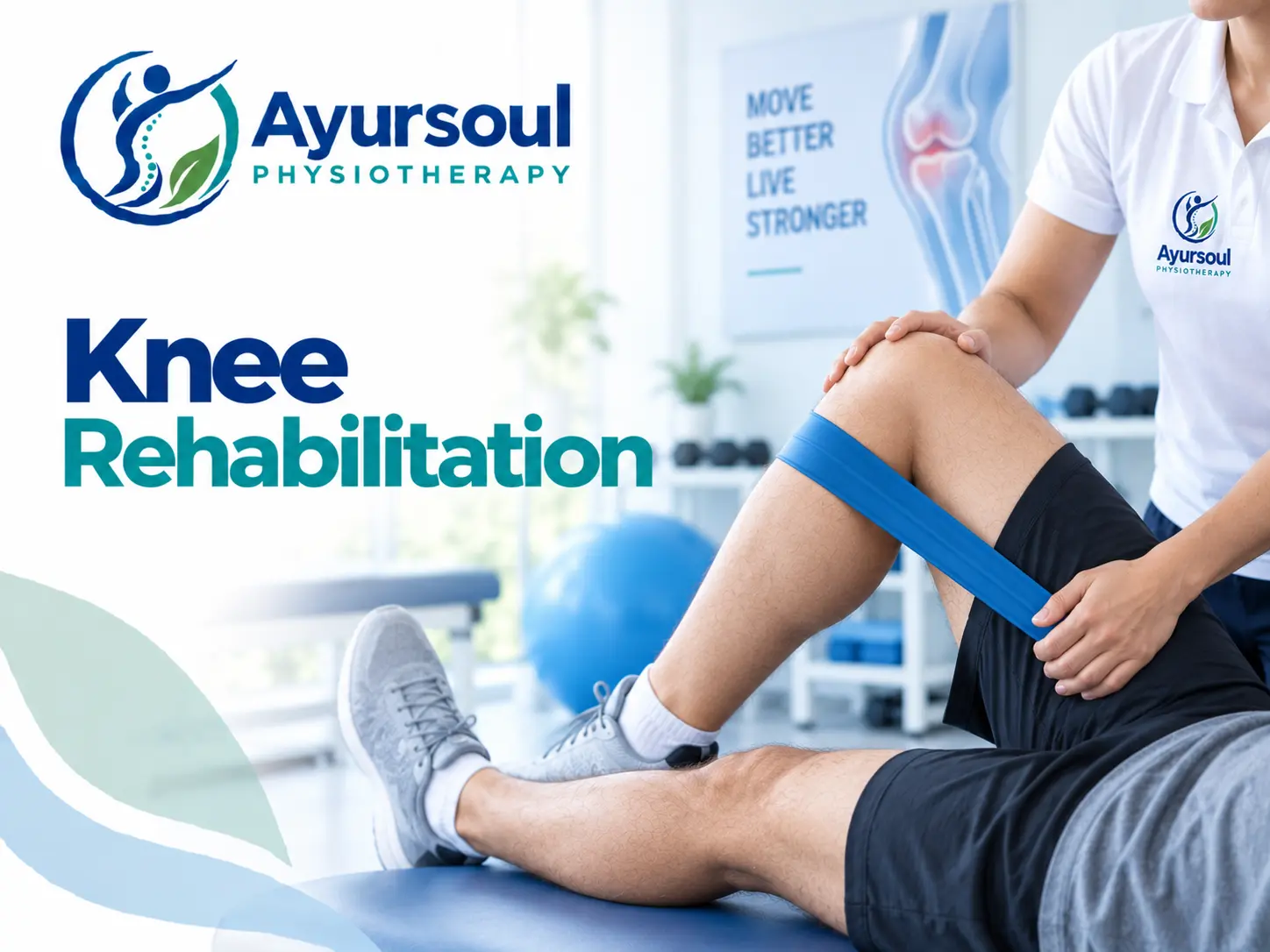
Need Help With Knee Rehabilitation?
If knee pain, stiffness, or recovery after injury or surgery is affecting your daily movement, you're welcome to book an assessment with Dr. Ashok K. Anand at Ayursoul Physiotherapy in Sector 75, Noida.
Knee rehabilitation refers to a structured physiotherapy programme designed for people recovering from knee surgery, ligament or meniscus injuries, or living with ongoing knee pain and stiffness related to conditions like osteoarthritis. It commonly involves a combination of guided exercise, hands-on techniques, and education aimed at helping the knee move and function better over time, depending on the individual's diagnosis and stage of recovery.
People seek out knee rehabilitation for many different reasons — after an ACL reconstruction or total knee replacement, following a sports injury or a fall, or simply because persistent knee pain has started to limit walking, climbing stairs, or daily activity. Symptoms can range from sharp pain and swelling in the early stages to a duller stiffness or sense of weakness that lingers well after the initial injury has settled.
At Ayursoul Physiotherapy in Sector 75, Noida, knee rehabilitation typically begins with a detailed assessment so that the plan that follows is suited to the specific injury, surgery, or condition involved, rather than a one-size-fits-all routine. Depending on what is found, physiotherapy may help support pain management, restore range of motion, and gradually rebuild the strength needed to return to everyday movement and activity.

Common Symptoms of Knee Rehabilitation
- Pain in or around the knee during walking, standing, or weight-bearing
- Swelling or puffiness around the joint
- Stiffness that makes bending or straightening the knee difficult, especially after rest
- A sense of the knee giving way, buckling, or feeling unstable
- Reduced ability to climb or descend stairs comfortably
- Noticeable weakness in the thigh muscles around the knee
- Clicking, catching, or locking sensations during movement
- Difficulty fully weight-bearing after an injury or surgical procedure
Common Causes & Risk Factors
Knee problems that lead to rehabilitation needs can arise from a single traumatic event or develop gradually over time. In many cases, the underlying cause shapes how a physiotherapy programme is structured, which is why an accurate history and assessment matter before treatment begins.
- Ligament injuries, such as ACL or MCL sprains and tears, often from sports or sudden twisting movements
- Meniscus tears from twisting, squatting, or degenerative wear
- Recovery following knee surgery, including ligament reconstruction, meniscus repair, or total or partial knee replacement
- Osteoarthritis or other degenerative joint changes affecting the knee over time
- Patellofemoral (kneecap) pain related to muscle imbalance or movement patterns
- Falls, direct trauma, or fractures around the knee joint
- Overuse from running, sports, or repetitive loading without adequate recovery
- Contributing biomechanical factors such as hip or foot alignment, muscle weakness, or prior injury
How Physiotherapy Helps
Physiotherapy for knee rehabilitation generally focuses on restoring safe movement, reducing pain and swelling where appropriate, and rebuilding the strength and control needed for daily activity or a return to sport, depending on the individual case. A physiotherapist may use a combination of guided exercise and hands-on manual therapy techniques to help address stiffness and support the healing process, always progressed according to the stage of recovery and any surgical or medical guidance already given.
Because every knee condition and every patient's goals are different, the approach used at one stage may look quite different from another — someone in the early weeks after knee replacement surgery will typically follow a different plan from someone managing long-standing arthritis or returning to running after an ACL injury. When clinically appropriate, a physiotherapist may also incorporate modalities such as electrotherapy or manual therapy alongside exercise to support the overall rehabilitation process.
What to Expect at Assessment
An initial assessment for knee rehabilitation usually starts with a conversation about the history of the problem — how and when it began, any surgery or imaging involved, and how it currently affects daily activity. This is generally followed by an observation of standing posture and walking pattern, measurement of knee range of motion, and testing of strength in the muscles around the knee and hip. Depending on the presentation, the physiotherapist may also carry out functional assessments such as squatting, stair negotiation, or single-leg balance, and relevant orthopaedic tests to help build a clearer picture of the knee's current status before a treatment plan is discussed.
How Treatment May Be Approached
The exact mix used depends on your assessment — not every technique below applies to every person.
Mobility Exercises
Gentle range-of-motion exercises may be introduced early, particularly after surgery or injury, to help address stiffness and support safe joint movement as healing allows.
Strengthening
A progressive strengthening programme for the thigh, hip, and calf muscles can be recommended to help support the knee joint and improve load tolerance over time.
Manual Therapy
Hands-on techniques may be used to help address stiffness, muscle tightness, or restricted movement around the knee, when clinically appropriate.
Therapeutic Exercise
A structured, staged exercise programme is often central to knee rehabilitation, with exercises adjusted as strength, control, and confidence improve.
Balance Training
Balance and proprioceptive exercises may be included, particularly after ligament injury or surgery, to help support joint stability and reduce the risk of further injury.
Functional Rehabilitation
As recovery progresses, exercises may be adapted toward specific goals such as walking distances, stair use, squatting, or a graded return to sport or work activities.
Electrotherapy
Electrotherapy may be used alongside exercise-based treatment in some cases to help support pain management as part of a broader rehabilitation plan.
Frequently Asked Questions
How soon after knee surgery can I start physiotherapy?
This depends on the type of surgery and your surgeon's specific guidance, so it's best to follow their post-operative protocol. Many knee surgeries do involve physiotherapy starting within the first few days to weeks, but the exact timing and exercises should be confirmed with your surgical team and physiotherapist.
Can physiotherapy help knee arthritis without surgery?
Physiotherapy may help manage symptoms of knee osteoarthritis by supporting joint mobility, muscle strength, and function, depending on the severity of the condition. It is not a cure and does not reverse joint changes, and some cases may still require medical or surgical input, so ongoing communication with your doctor is important.
How long does knee rehabilitation usually take?
The timeline varies considerably depending on the underlying condition, whether surgery was involved, and individual factors like age and activity level. A physiotherapist can give a more specific estimate after assessment, but recovery from significant injuries or surgery often spans several weeks to a few months.
Is it normal for my knee to still feel weak weeks after injury?
Some degree of muscle weakness, particularly in the thigh, is common after knee injury or a period of reduced activity, and this is often part of what a rehabilitation exercise programme aims to address. Persistent or worsening weakness should still be discussed with your physiotherapist so it can be properly assessed.
Do I need a doctor's referral to start physiotherapy for my knee?
A referral is not always required, and you can typically be assessed directly by a physiotherapist. That said, if you have had recent surgery, a suspected fracture, or significant trauma, coordinating with your treating doctor or surgeon is recommended.
Will physiotherapy exercises hurt my knee?
Some mild discomfort during exercise can be normal as movement and strength are rebuilt, but exercises should generally be manageable and are adjusted based on your response. Sharp, worsening, or lasting pain should be reported to your physiotherapist so the programme can be reviewed.
Can I do knee rehabilitation exercises at home?
Many knee rehabilitation programmes include exercises intended to be done at home between clinic visits, once you've been shown correct technique. A physiotherapist can guide you on which exercises are appropriate for your stage of recovery and how to progress them safely.
Clinical Evidence & References
The physiotherapy approaches discussed on this page are informed by published clinical research and evidence-based rehabilitation literature. Selected references are provided below for further reading.
-
McAlindon TE, Bannuru RR, Sullivan MC, Arden NK, Berenbaum F, Bierma-Zeinstra SM, et al. OARSI guidelines for the non-surgical management of knee osteoarthritis. Osteoarthritis Cartilage. 2014;22(3):363-88. PMID: 24462672. DOI: 10.1016/j.joca.2014.01.003.
Clinical practice guideline This 2014 international knee osteoarthritis guideline rated exercise and self-management appropriate for all patients, TENS of uncertain appropriateness, and neuromuscular electrical stimulation not appropriate.
-
Lawford BJ, Hall M, Hinman RS, Van der Esch M, Harmer AR, Spiers L, et al. Exercise for osteoarthritis of the knee. Cochrane Database Syst Rev. 2024;12(12):CD004376. PMID: 39625083. DOI: 10.1002/14651858.CD004376.pub4.
Cochrane review Across 139 trials, exercise probably improved knee osteoarthritis pain and function in the short term (low- to moderate-certainty evidence), but benefits were modest and of uncertain clinical importance.
-
Artz N, Elvers KT, Lowe CM, Sackley C, Jepson P, Beswick AD. Effectiveness of physiotherapy exercise following total knee replacement: systematic review and meta-analysis. BMC Musculoskelet Disord. 2015;16:15. PMID: 25886975. DOI: 10.1186/s12891-015-0469-6.
Systematic review and meta-analysis Across 18 trials after knee replacement, physiotherapy exercise improved function and pain at 3-4 months versus minimal care, but trials were small and no long-term benefit was shown.
-
Qu H, Zhen Q, Li H, Jiang Q, Cao X, Zhang L, et al. Effects of Balance and Proprioceptive Training on Rehabilitation After Total Knee and Total Hip Replacement: A Systematic Review and Meta-Analysis. J Aging Phys Act. 2026;34(1):82-90. PMID: 40957586. DOI: 10.1123/japa.2024-0390.
Systematic review and meta-analysis Across 19 trials after knee or hip replacement, balance or proprioceptive training was generally no better than conventional exercise for pain, function or balance measures.
-
Abbott JH, Robertson MC, Chapple C, Pinto D, Wright AA, Leon de la Barra S, et al. Manual therapy, exercise therapy, or both, in addition to usual care, for osteoarthritis of the hip or knee: a randomized controlled trial. 1: clinical effectiveness. Osteoarthritis Cartilage. 2013;21(4):525-34. PMID: 23313532. DOI: 10.1016/j.joca.2012.12.014.
Randomized controlled trial In 206 adults with hip or knee osteoarthritis, manual physiotherapy improved symptoms over usual care at one year, but combining it with exercise gave no extra benefit.