
Rotator Cuff Injury Physiotherapy in Noida
Rotator cuff injury physiotherapy in Noida with Dr. Ashok K. Anand. Assessment-led care for tendon pain, weakness, and impingement at Spectrum Mall, Sector 75.
Visit Ayursoul Physiotherapy Clinic
Ayursoul Healthcare, Spectrum Mall, Sector 75, Noida, Uttar Pradesh
Open daily: 10:00 AM – 8:00 PM
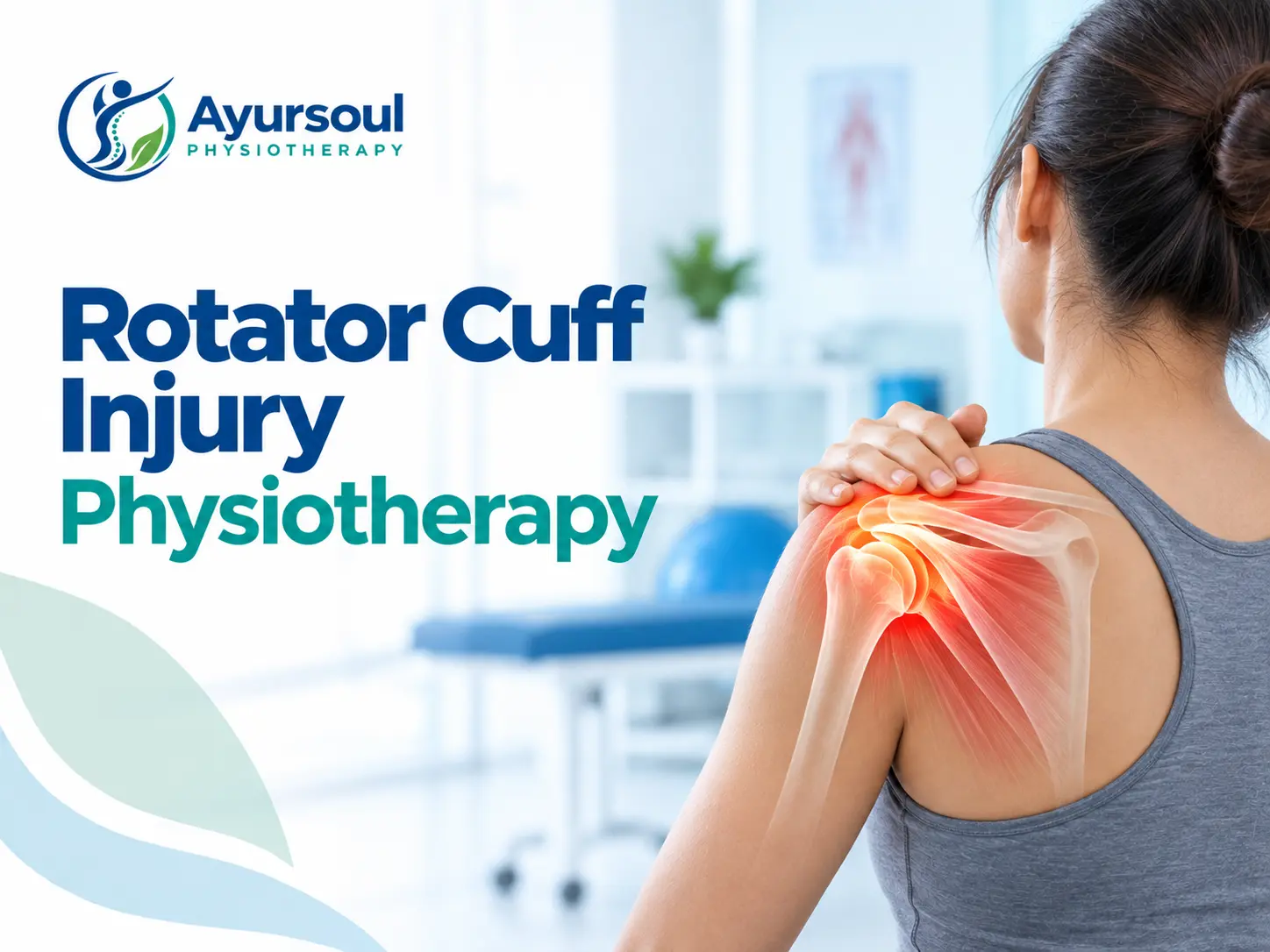
Need Help With Rotator Cuff Injury Physiotherapy?
If shoulder pain, weakness, or difficulty lifting your arm is affecting your daily activities, consider booking a physiotherapy assessment with Dr. Ashok K. Anand (MBBS, CAc, FEA (UK)) at Ayursoul Physiotherapy, Spectrum Mall, Sector 75, Noida, or call +91 88003 68078 to discuss your symptoms.
A rotator cuff injury refers to irritation, inflammation, or damage to the group of four muscles and their tendons that surround the shoulder joint and help lift and rotate the arm. This can range from mild tendon irritation (tendinopathy) to a partial or, less commonly, a full tendon tear, and it is one of the more frequent causes of shoulder pain seen in physiotherapy practice.
It tends to affect people who repeatedly raise their arms overhead — such as painters, drivers, badminton or throwing-sport players, and swimmers — as well as those in the middle-to-older age groups where tendon tissue can become more vulnerable to wear over time. A fall or sudden strain can also trigger symptoms in an otherwise healthy shoulder.
Physiotherapy assessment may help identify the likely pattern of injury and its probable contributing factors, and a tailored treatment plan may help manage pain, support tendon healing, and gradually restore shoulder strength and function. This page is intended for general information and does not replace an in-person clinical assessment or diagnosis.
Common Symptoms of Rotator Cuff Injury Physiotherapy
- Dull, deep ache in the shoulder that may worsen with overhead reaching or lifting
- Weakness when raising the arm to the side or overhead
- Pain or discomfort when lying on the affected shoulder at night
- A catching, clicking, or grinding sensation during certain arm movements
- Difficulty reaching behind the back, such as fastening a bra or tucking in a shirt
- Sharp pain with specific movements like lifting a bag or reaching into a cupboard
- Reduced ability to lift or carry objects with the affected arm
- Gradual weakening of grip or arm strength over weeks or months
Common Causes & Risk Factors
Rotator cuff injuries can develop gradually from repetitive strain or appear suddenly after a specific incident. In many cases, a combination of factors contributes to the tendon becoming irritated, inflamed, or torn over time.
- Repetitive overhead activity at work or in daily life (painting, reaching into overhead cupboards, prolonged computer use with poor arm support)
- Overhead sports or activities such as badminton, throwing sports, or swimming that load the shoulder repeatedly
- A fall onto an outstretched arm or a sudden jerking movement while lifting
- Age-related wear of the tendon, which is more common beyond the mid-40s as tendon tissue naturally loses some of its elasticity
- Poor posture and rounded shoulders, which may narrow the space the rotator cuff tendons pass through during arm movement
- Weakness or imbalance in the muscles that stabilise the shoulder blade, placing extra demand on the rotator cuff
- Previous shoulder injury or impingement that was not fully rehabilitated
- Occupations involving frequent lifting, carrying, or working with the arms raised for long periods
The exact cause and severity can vary considerably from person to person, and a physiotherapy or medical assessment is the best way to understand what may be contributing in an individual case.
How Physiotherapy Helps
Physiotherapy for rotator cuff injuries generally focuses on reducing pain and irritation in the affected tendons, restoring pain-free range of motion, and gradually rebuilding strength in the muscles that stabilise and move the shoulder. Depending on the assessment findings, Manual Therapy may be used to address stiffness in surrounding joints and soft tissue, while Dry Needling, Medical Acupuncture, or Cupping Therapy may be considered to help manage localised muscular tension and pain. Modalities such as Ultrasound Therapy, Laser Therapy, and Electrotherapy may also be used as adjuncts alongside hands-on treatment and exercise, where clinically appropriate for the individual.
A graded exercise programme is usually central to rehabilitation, progressing from gentle range-of-motion and scapular control exercises toward targeted rotator cuff strengthening as tolerated. Myofascial Release and Trigger Point Therapy may be used to address tight surrounding muscles such as the upper trapezius or pectorals that can alter shoulder mechanics, and Kinesio Taping is sometimes applied to provide feedback or support during the early stages of loading. Ergonomic Assessment may also be discussed where repetitive work postures or overhead demands appear to be contributing to the problem, so that day-to-day habits can be adjusted alongside the treatment plan.
If you have had or are considering rotator cuff surgery, our dedicated Shoulder Surgery Rehabilitation pathway outlines the phased, week-by-week post-operative recovery process in more detail — the guidance on this page focuses on the injury and non-surgical care rather than a structured post-op timeline.
What to Expect at Assessment
An assessment for a suspected rotator cuff problem typically starts with a detailed history — how the shoulder pain began, whether there was a specific injury or fall, what movements or positions aggravate it, and whether night pain or weakness is present. The physiotherapist may then examine active and passive shoulder range of motion, compare strength across the different rotator cuff muscles, and use a series of orthopaedic special tests that help distinguish a possible cuff tendon problem from impingement, frozen shoulder, or referred neck pain. Posture, shoulder blade positioning, and movement patterns during arm elevation are often observed as well, since these can influence how much load the rotator cuff tendons are exposed to. Where findings are unclear or symptoms are severe, referral for imaging (such as ultrasound or MRI) or an orthopaedic opinion may be suggested alongside physiotherapy.
How Treatment May Be Approached
The exact mix used depends on your assessment — not every technique below applies to every person.
Manual Therapy
Hands-on joint mobilisation and soft tissue techniques may be used to address stiffness in the shoulder and surrounding structures, when clinically appropriate.
Rotator Cuff Strengthening Exercises
A graded, progressive exercise programme targeting the specific rotator cuff muscles may be introduced once irritability has settled, building load tolerance over time.
Scapular Control and Postural Retraining
Exercises to improve shoulder blade positioning and control may be used to reduce excess strain on the rotator cuff tendons during arm movement.
Dry Needling and Medical Acupuncture
These may be considered to help address localised muscular tightness and pain around the shoulder girdle, where suitable for the individual.
Electrotherapy, Ultrasound and Laser Therapy
These modalities may be used as adjuncts alongside manual treatment and exercise to help manage pain and support tissue healing.
Kinesio Taping and Ergonomic Assessment
Taping may provide feedback or light support during early rehabilitation, while an ergonomic review may help identify and modify aggravating work or daily postures.
Frequently Asked Questions
Is a rotator cuff injury the same as frozen shoulder?
No. A rotator cuff injury involves the tendons and muscles that lift and rotate the shoulder, and pain is usually linked to specific movements or overhead activity. Frozen shoulder involves stiffening and tightening of the joint capsule itself, causing a progressive, often more global loss of movement in most directions. The two conditions can sometimes coexist, so an assessment is used to help clarify which pattern is present.
Can a rotator cuff tear heal without surgery?
Many partial tears and tendon irritation (tendinopathy) cases are managed conservatively with physiotherapy, activity modification, and a structured exercise programme, and can improve over time. Whether surgery is needed depends on factors such as tear size, symptom severity, and response to conservative care, which is best discussed with an orthopaedic specialist alongside your physiotherapist.
What does rotator cuff pain typically feel like?
It commonly presents as a dull ache deep in the shoulder, often worse with overhead reaching, lifting, or lying on the affected side at night. Some people also notice a catching or weak sensation when raising the arm, particularly between certain angles of movement.
How is a rotator cuff injury different from shoulder impingement?
Impingement refers to compression of the rotator cuff tendons or bursa as they pass through a narrow space during arm movement, and it can be a contributing factor to tendon irritation. A rotator cuff injury refers more specifically to damage within the tendon or muscle tissue itself, which impingement can sometimes lead to over time. There is often overlap, and assessment helps clarify the dominant pattern.
Will I need an MRI or ultrasound scan?
Not always. Many rotator cuff problems can be assessed clinically through history and physical tests. Imaging may be suggested if symptoms are severe, not improving as expected, if a significant tear is suspected, or if surgical opinion is being considered.
How many physiotherapy sessions are usually needed?
This varies widely depending on the severity of the injury, how long symptoms have been present, and individual response to treatment. Your physiotherapist can give a more specific estimate after the initial assessment, and progress is typically reviewed and adjusted along the way.
Can I keep exercising or playing sports with a rotator cuff injury?
Some modification of activity is often recommended, particularly overhead movements that reproduce pain, while a physiotherapist guides you through appropriate strengthening and mobility work. Returning to full sport or heavy lifting is usually a gradual, monitored process rather than an immediate resumption.
What happens if a rotator cuff injury is left untreated?
Ongoing tendon irritation can sometimes lead to worsening pain, progressive weakness, or a small tear enlarging over time in some individuals, though this is not universal. If you notice increasing weakness, significant loss of arm function, or pain that is not settling, prompt evaluation is advisable.
Clinical Evidence & References
The physiotherapy approaches discussed on this page are informed by published clinical research and evidence-based rehabilitation literature. Selected references are provided below for further reading.
-
Page MJ, Green S, McBain B, Surace SJ, Deitch J, Lyttle N, et al. Manual therapy and exercise for rotator cuff disease. Cochrane Database Syst Rev. 2016;2016(6):CD012224. PMID: 27283590. DOI: 10.1002/14651858.CD012224.
Cochrane review A Cochrane review found manual therapy plus exercise gave no clinically important benefit over placebo in one high-quality trial, and possibly similar results to injection or surgery (low-quality evidence).
-
Page MJ, Green S, Mrocki MA, Surace SJ, Deitch J, McBain B, et al. Electrotherapy modalities for rotator cuff disease. Cochrane Database Syst Rev. 2016;2016(6):CD012225. PMID: 27283591. DOI: 10.1002/14651858.CD012225.
Cochrane review A Cochrane review found low-quality evidence that ultrasound (calcific tendinitis) and laser may help short term versus placebo, but little or no added benefit alongside other physiotherapy.
-
Karjalainen TV, Jain NB, Heikkinen J, Johnston RV, Page CM, Buchbinder R. Surgery for rotator cuff tears. Cochrane Database Syst Rev. 2019;12(12):CD013502. PMID: 31813166. DOI: 10.1002/14651858.CD013502.
Cochrane review A Cochrane review found repair surgery probably adds little or no pain relief over exercise at one year for mostly small degenerative tears; findings may not apply to traumatic tears.
-
Doiron-Cadrin P, Lafrance S, Saulnier M, Cournoyer É, Roy JS, Dyer JO, et al. Shoulder Rotator Cuff Disorders: A Systematic Review of Clinical Practice Guidelines and Semantic Analyses of Recommendations. Arch Phys Med Rehabil. 2020;101(7):1233-1242. PMID: 32007452. DOI: 10.1016/j.apmr.2019.12.017.
Systematic review A systematic review of nine guidelines found all recommended active treatment such as exercise for rotator cuff disorders, though only three guidelines were of high methodological quality.
-
Luo Y, Zhang L, Tang Z, Chen L, Zhou D, Huang H. The efficacy of kinesiology tape for rotator cuff injuries: a meta-analysis of randomized trials. Front Med (Lausanne). 2025;12:1695350. PMID: 41293732. DOI: 10.3389/fmed.2025.1695350.
Systematic review and meta-analysis A 2025 meta-analysis of 17 trials found kinesiology taping gave modest improvements in shoulder pain and movement, but results varied widely between studies and need cautious interpretation.
-
Kamali F, Sinaei E, Morovati M. Comparison of Upper Trapezius and Infraspinatus Myofascial Trigger Point Therapy by Dry Needling in Overhead Athletes With Unilateral Shoulder Impingement Syndrome. J Sport Rehabil. 2019;28(3):243-249. PMID: 29364040. DOI: 10.1123/jsr.2017-0207.
Randomized controlled trial In 40 overhead athletes with shoulder impingement, needling infraspinatus or upper trapezius trigger points gave similar short-term pain and disability improvements; the trial had no sham or untreated control.
-
Kuhn JE, Dunn WR, Sanders R, An Q, Baumgarten KM, Bishop JY, et al. Effectiveness of physical therapy in treating atraumatic full-thickness rotator cuff tears: a multicenter prospective cohort study. J Shoulder Elbow Surg. 2013;22(10):1371-9. PMID: 23540577. DOI: 10.1016/j.jse.2013.01.026.
Prospective cohort study In 452 patients with atraumatic full-thickness cuff tears, symptoms improved with structured physiotherapy and about three in four had not chosen surgery by two years (no control group).