
Posture-Related Pain Physiotherapy in Noida
Struggling with neck, shoulder or back pain from poor posture or desk work? Ayursoul Physiotherapy in Noida offers assessment-based care for postural pain.
Visit Ayursoul Physiotherapy Clinic
Ayursoul Healthcare, Spectrum Mall, Sector 75, Noida, Uttar Pradesh
Open daily: 10:00 AM – 8:00 PM
Need Help With Posture-Related Pain Physiotherapy?
If postural neck, shoulder or back discomfort is affecting your daily routine, you can book a physiotherapy assessment with Dr. Ashok K. Anand at Ayursoul Physiotherapy, Spectrum Mall, Sector 75, Noida, or call +91 88003 68078 to schedule a visit.
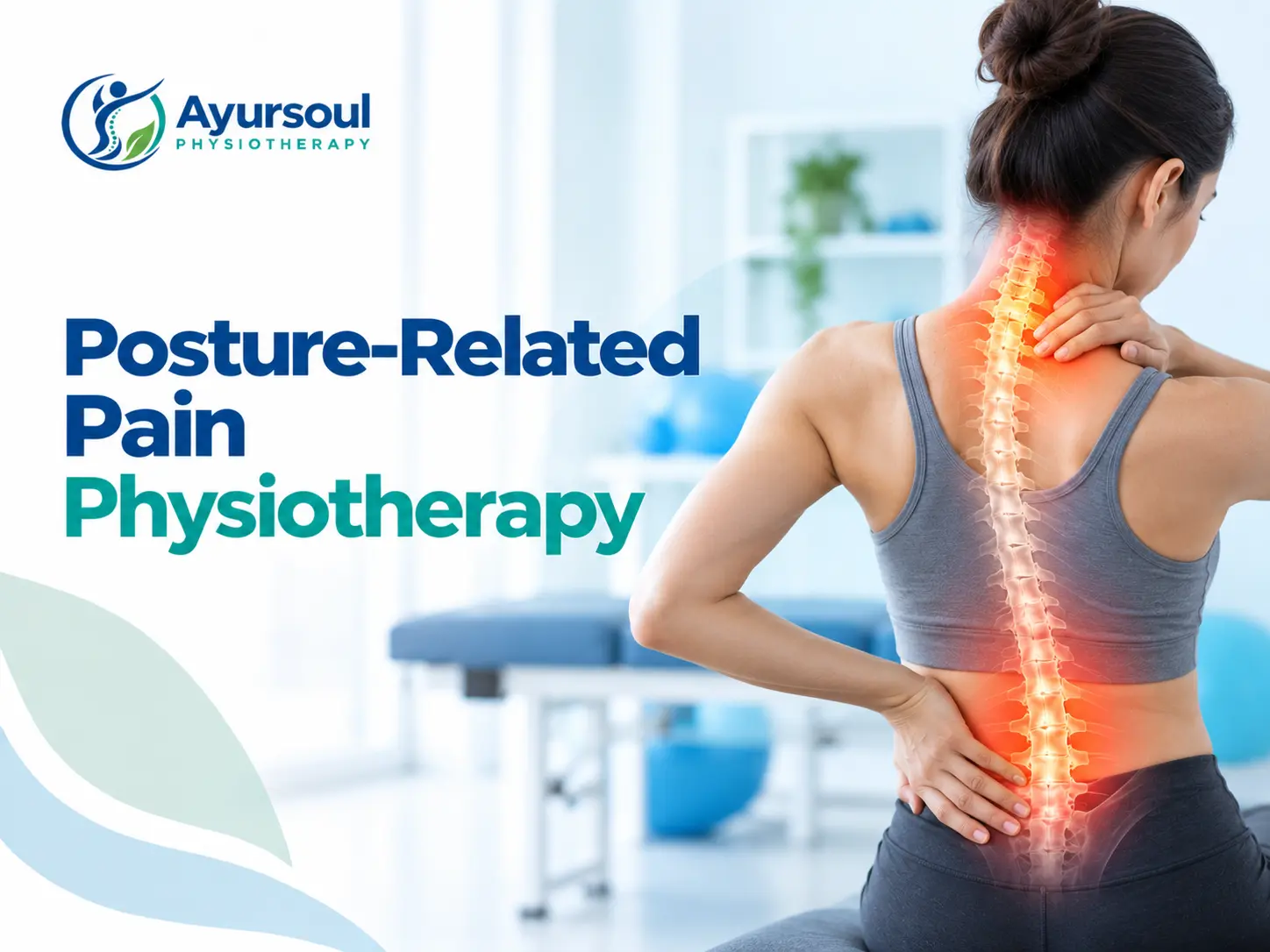
Posture-related pain refers to the neck, shoulder, upper back or lower back discomfort that can build up gradually from sustained positions — long hours at a desk, looking down at a phone, or sitting without adequate back support. It is one of the more common complaints seen in people with desk-based jobs, students, and anyone spending extended periods on screens, and it often shows up as a dull ache, stiffness or tension rather than a sudden sharp pain.
Patterns like a forward-leaning head, rounded shoulders and a slouched sitting position (sometimes described informally as "tech neck" or "upper crossed syndrome") are frequently associated with this type of discomfort. While it is rarely linked to anything serious, ongoing postural strain can affect daily comfort, concentration and sleep if left unaddressed.
Physiotherapy may help by identifying which muscles and joints appear to be under strain and offering hands-on and modality-based care to ease discomfort, alongside guidance on habits that may be contributing to the pattern. Since postural pain and its causes vary from person to person, an individual assessment is generally the starting point before any care plan is suggested.

Common Symptoms of Posture-Related Pain Physiotherapy
- Dull, aching pain across the upper back and between the shoulder blades after prolonged sitting
- Neck stiffness and soreness that worsens with extended screen or phone use ("tech neck")
- Rounded shoulders with tightness across the chest and weakness between the shoulder blades
- Recurring tension-type headaches starting at the base of the skull
- Lower back ache that builds through the day, especially with slouched sitting
- A forward-leaning head posture with a sense of neck heaviness by evening
- Fatigue or tightness in the neck and shoulder muscles that eases with movement or stretching
- Discomfort that improves over the weekend or during breaks from desk work but returns with routine
Common Causes & Risk Factors
Posture-related pain usually develops gradually, from sustained positions and habits rather than a single injury. Common contributing factors may include:
- Prolonged sitting at a desk or computer with limited movement breaks
- Frequent use of laptops or phones in a forward-leaning, head-down position ("tech neck")
- A poorly set up workstation — screen too low, chair without support, or keyboard positioned awkwardly
- Weakness in the deep neck flexors and muscles between the shoulder blades that normally support upright posture
- Tightness in the chest and front-of-shoulder muscles that pulls the shoulders forward
- Long hours of driving or travel with inadequate back support
- Habitually carrying a bag, laptop case or child on one side of the body
- Stress or fatigue, which can increase muscle tension around the neck and shoulders
- Sleeping positions or pillow height that do not support the neck's natural alignment
These factors often act together, and the exact combination behind your discomfort can vary from person to person, which is why an individual assessment matters.
How Physiotherapy Helps
Physiotherapy for posture-related pain generally focuses on easing current muscle and joint tension while addressing some of the habits that may be contributing to it. Depending on the assessment findings, a physiotherapist may use manual therapy to loosen stiff areas of the neck and upper back, myofascial release or trigger point therapy for tight bands of muscle around the shoulders and upper trapezius, and modalities such as ultrasound or electrotherapy where appropriate to help with pain relief in the affected area.
An ergonomic assessment of your workstation or daily setup may also form part of the plan, along with kinesio taping in some cases to provide postural feedback during activity. For the structured assessment-and-exercise side of postural retraining, our dedicated Posture Correction page covers those techniques in more detail — this page focuses specifically on understanding and addressing the pain itself.
What to Expect at Assessment
A physiotherapy assessment for posture-related pain typically begins with a discussion of your daily routine — hours spent sitting, screen and phone habits, sleep position and any past injuries — followed by an observational posture analysis in standing and sitting. The physiotherapist may screen movement patterns of the neck, shoulders and spine, check the length and strength of key muscle groups (such as the chest, upper trapezius, deep neck flexors and scapular stabilisers), and assess your workstation or lifestyle setup where relevant. This helps build an individualised picture of which postural patterns may be contributing to your pain, rather than assuming one standard cause for everyone.
How Treatment May Be Approached
The exact mix used depends on your assessment — not every technique below applies to every person.
Manual Therapy
Hands-on techniques may be used to ease stiffness and restore movement in the neck, upper back and shoulder region.
Myofascial Release
May be used to address fascial tightness commonly found around the upper trapezius and shoulder blades in postural pain patterns.
Trigger Point Therapy
May help address hyperirritable muscle points often felt in the neck and upper back with prolonged poor posture.
Ergonomic Assessment
A review of workstation setup, chair support, screen height and daily habits may be carried out when clinically appropriate.
Electrotherapy and Ultrasound Therapy
These modalities may be used adjunctively for short-term pain relief and muscle relaxation, where suitable.
Kinesio Taping
May be used in some cases to provide postural feedback or gentle support during daily activity.
Frequently Asked Questions
Is posture-related pain the same as a slipped disc or arthritis?
Not usually. Posture-related pain is generally linked to sustained muscle and joint strain from prolonged positions rather than structural damage, though long-standing poor posture can sometimes contribute to other conditions over time. A physiotherapy assessment can help clarify what may be contributing to your specific symptoms.
Can sitting at a desk all day really cause this kind of pain?
Prolonged, unbroken sitting with a forward head and rounded shoulder position is one of the most commonly reported contributors to postural neck, upper back and lower back discomfort, especially when combined with limited movement through the day.
What is "tech neck" and is it a real diagnosis?
"Tech neck" is a descriptive term, not a formal medical diagnosis. It refers to the neck strain pattern associated with looking down at phones or laptops for extended periods, which may contribute to neck stiffness and related headaches in some people.
Will I need X-rays or scans before starting physiotherapy?
Not routinely. Postural pain is often assessed through a physical and movement-based evaluation. Imaging may occasionally be suggested if there are red-flag symptoms or if pain does not respond as expected, at the clinician's discretion.
How is this different from the posture correction and exercise programme on your site?
This page focuses on understanding postural pain itself — what it feels like, common patterns and when to seek care. Our dedicated posture correction page covers the assessment and exercise techniques used to help address postural habits in more detail.
Can postural pain come back after it settles?
It's possible, particularly if the underlying habits (workstation setup, prolonged sitting, screen posture) remain unchanged. Ongoing awareness and periodic review are often part of managing postural discomfort long-term.
Are headaches always connected to posture?
Not always, but tension-type headaches that start at the base of the skull are sometimes associated with tightness in the upper neck and shoulder muscles linked to sustained poor posture. Other causes should be considered as well.
How soon might I notice a difference with physiotherapy?
This varies by individual, based on how long symptoms have been present and how consistently any recommended changes are followed. Your physiotherapist can give you a more personalised sense of what to expect after your assessment.
Clinical Evidence & References
The physiotherapy approaches discussed on this page are informed by published clinical research and evidence-based rehabilitation literature. Selected references are provided below for further reading.
-
Bier JD, Scholten-Peeters WGM, Staal JB, Pool J, van Tulder MW, Beekman E, et al. Clinical Practice Guideline for Physical Therapy Assessment and Treatment in Patients With Nonspecific Neck Pain. Phys Ther. 2018;98(3):162-171. PMID: 29228289. DOI: 10.1093/ptj/pzx118.
Clinical practice guideline A Dutch physiotherapy guideline for non-specific neck pain recommends advice and exercise, adding mobilisation or manipulation if recovery is slow, and advises against ultrasound, electrotherapy and dry needling.
-
Mahmoud NF, Hassan KA, Abdelmajeed SF, Moustafa IM, Silva AG. The Relationship Between Forward Head Posture and Neck Pain: a Systematic Review and Meta-Analysis. Curr Rev Musculoskelet Med. 2019;12(4):562-577. PMID: 31773477. DOI: 10.1007/s12178-019-09594-y.
Systematic review and meta-analysis Across 15 cross-sectional studies, adults with neck pain had more forward head posture than pain-free adults, a link not seen in adolescents; these studies show association, not cause.
-
Benetton A, Battista S, Bertoni G, Rossettini G, Maistrello LF. Effectiveness of Manual Joint Mobilization Techniques in the Treatment of Nonspecific Neck Pain: Systematic Review With Meta-Analysis and Meta-Regression of Randomized Controlled Trials. J Orthop Sports Phys Ther. 2025;55(3):1-20. PMID: 40019107. DOI: 10.2519/jospt.2025.12836.
Systematic review and meta-analysis Neck joint mobilisation reduced pain and disability only slightly, below clinically meaningful levels, compared with other care or no treatment, and the evidence was of very low certainty.
-
Qing W, Shi X, Zhang Q, Peng L, He C, Wei Q. Effect of Therapeutic Ultrasound for Neck Pain: A Systematic Review and Meta-Analysis. Arch Phys Med Rehabil. 2021;102(11):2219-2230. PMID: 33722564. DOI: 10.1016/j.apmr.2021.02.009.
Systematic review and meta-analysis Therapeutic ultrasound may reduce neck pain more than sham or no treatment, but whether it adds benefit to other treatments was unclear, from trials of varying quality.
-
Hu Q, Liu Y, Yin S, Zou H, Shi H, Zhu F. Effects of Kinesio Taping on Neck Pain: A Meta-Analysis and Systematic Review of Randomized Controlled Trials. Pain Ther. 2024;13(5):1031-1046. PMID: 39039345. DOI: 10.1007/s40122-024-00635-0.
Systematic review and meta-analysis Pooling 10 randomised trials (620 patients), kinesio taping reduced neck pain slightly more than conventional treatment or sham, though its role in postural feedback was not studied.