
Tennis Elbow Physiotherapy in Noida
Struggling with outer elbow pain from tennis elbow (lateral epicondylitis)? Physiotherapy at AyurSoul Noida may help ease pain and support recovery.
Visit Ayursoul Physiotherapy Clinic
Ayursoul Healthcare, Spectrum Mall, Sector 75, Noida, Uttar Pradesh
Open daily: 10:00 AM – 8:00 PM
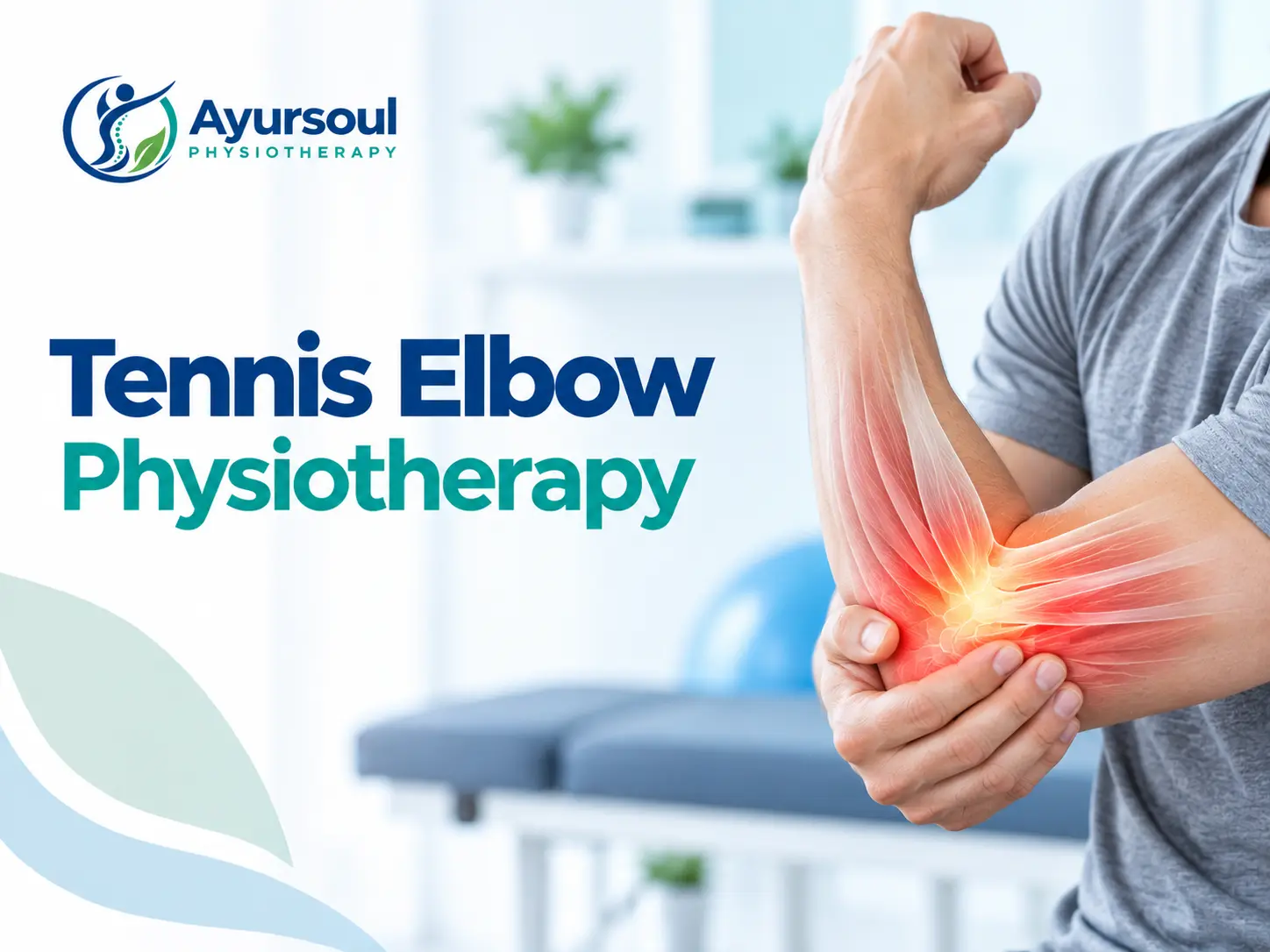
Need Help With Tennis Elbow Physiotherapy?
If outer-elbow pain is limiting your grip or daily activities, consider booking a physiotherapy assessment with Dr. Ashok K. Anand at Ayursoul Physiotherapy, Spectrum Mall, Sector 75, Noida, by calling +91 88003 68078.
Tennis elbow, medically known as lateral epicondylitis, is a common cause of pain on the outside of the elbow, usually linked to overuse of the forearm muscles and tendons that control wrist and finger extension. It tends to affect adults roughly between 30 and 50 years of age, and while its name suggests a sporting injury, most people who develop it have never played tennis — it is often related to repetitive hand and wrist activity at work or at home.
Tennis elbow is one of several possible reasons for pain around the elbow joint; if you're not sure whether your symptoms match this specific pattern, our Elbow Pain Physiotherapy page covers the broader range of conditions that can cause elbow discomfort.
Physiotherapy is often suggested as a first-line, non-surgical approach for tennis elbow. It may help by addressing pain, guiding you through a structured loading and strengthening program, and identifying activity or technique changes that could reduce ongoing strain — though individual response to treatment can vary, and a physiotherapist can advise on what may be realistic for your specific situation.

Common Symptoms of Tennis Elbow Physiotherapy
- Pain or tenderness on the outer (lateral) side of the elbow
- Pain that may radiate down the forearm toward the wrist
- Weak or painful grip, such as difficulty shaking hands or holding a cup
- Discomfort when lifting, gripping, or twisting objects (e.g. turning a doorknob or wringing a cloth)
- Pain that worsens with wrist extension or resisted finger straightening
- Stiffness in the elbow, particularly first thing in the morning
- Symptoms that gradually build up over weeks with repetitive activity rather than appearing suddenly
- Localised tenderness when pressing on the bony point on the outside of the elbow
Common Causes & Risk Factors
Tennis elbow is generally understood as an overuse-related strain of the tendons that attach to the bony bump on the outside of the elbow, usually from repeated gripping and wrist-extension movements. Despite the name, it is seen far more often in people who never pick up a racquet than in tennis players. Some possible contributing factors include:
- Repetitive gripping, twisting or wrist-extension movements at work (e.g. typing, using tools, plumbing, painting, carpentry)
- Racquet sports such as tennis, badminton or squash, especially with a faulty backhand technique or an ill-fitting grip
- Sudden increase in hand-intensive activity or a new repetitive task the forearm isn't conditioned for
- Poor forearm and wrist strength or reduced flexibility around the elbow
- Prolonged computer mouse use or awkward wrist positioning during daily tasks
- Age-related changes in tendon quality, most commonly seen between the ages of 30 and 50
- Smoking and certain metabolic factors, which some research associates with slower tendon healing
These are commonly reported contributing factors, and the exact cause can vary from person to person — often more than one factor is involved.
How Physiotherapy Helps
Physiotherapy for tennis elbow generally focuses on calming irritated tendon tissue, gradually rebuilding the forearm's tolerance to load, and identifying activities or techniques that may be feeding the problem. A physiotherapist may use hands-on techniques such as Manual Therapy, Myofascial Release or Trigger Point Therapy around the forearm and elbow to help ease muscle tightness, alongside modalities like Ultrasound Therapy, Laser Therapy or Electrotherapy, which are sometimes used to help manage pain and support the local healing environment. Dry Needling may also be considered for persistent, localised muscle tightness when clinically appropriate.
Alongside these approaches, a structured exercise program — often built around gradual, controlled loading of the wrist-extensor tendons — is usually a central part of care, together with Kinesio Taping for temporary support during activity and an Ergonomic Assessment to review grip, workstation setup or sporting technique that may be contributing to symptoms. The specific combination used depends on your presentation, how long you've had symptoms, and your response to treatment, and is decided by your physiotherapist rather than applied as a one-size-fits-all protocol.
What to Expect at Assessment
A physiotherapy assessment for suspected tennis elbow typically begins with a discussion of your symptoms, hand-dominant activities, sport or occupational demands, and how the pain behaves through the day. The physiotherapist may palpate the outer elbow to locate the area of maximum tenderness, and use provocative tests such as resisted wrist extension, resisted middle-finger extension, or grip strength testing to help reproduce your symptoms. Wrist, forearm and shoulder movement, posture, and grip technique (if you play racquet sports or use tools repetitively) may also be reviewed, since these can contribute to ongoing strain at the elbow. This assessment helps the physiotherapist understand the likely contributing factors and build a plan tailored to you; it is not a substitute for a medical diagnosis, and your physiotherapist may recommend a medical review or imaging if the presentation is unclear or not improving as expected.
How Treatment May Be Approached
The exact mix used depends on your assessment — not every technique below applies to every person.
Manual Therapy
Hands-on techniques may be used to help address forearm muscle tightness and stiffness around the elbow, when clinically appropriate.
Progressive Loading & Exercise Therapy
A graded program of eccentric and isometric wrist-extensor exercises is often central to care, gradually building tendon tolerance to load.
Dry Needling
May be used for persistent, localised muscle tightness or trigger points contributing to forearm tension, when clinically appropriate.
Ultrasound & Laser Therapy
These modalities may be used alongside other treatment to help manage pain and support the local tissue environment during recovery.
Kinesio Taping
May be applied to provide temporary support to the forearm muscles during activity or as symptoms are being managed.
Ergonomic Assessment & Activity Modification
Reviewing grip technique, workstation setup, or sporting equipment may help identify and reduce factors contributing to ongoing strain.
Frequently Asked Questions
Is tennis elbow only caused by playing tennis?
No. While it is named after the sport, most people with tennis elbow have never played tennis or badminton. It is more commonly linked to repetitive gripping and wrist movements at work, on hobbies, or with household tasks.
How long does tennis elbow usually take to settle?
Recovery timelines vary a lot between individuals depending on how long symptoms have been present, activity demands, and how consistently a management plan is followed. Physiotherapy aims to support the process, but no fixed timeframe can be promised.
Can I keep working or playing sport with tennis elbow?
This depends on how irritable your symptoms are. A physiotherapist may suggest temporary activity modification, grip or technique changes, and a gradual return-to-activity plan rather than complete rest in most cases.
Will I need an X-ray or scan for tennis elbow?
Tennis elbow is often assessed clinically through history and specific physical tests, without imaging. Your physiotherapist may suggest referral for an X-ray or ultrasound if symptoms are atypical, severe, or not responding as expected.
What is the difference between tennis elbow and golfer's elbow?
Tennis elbow (lateral epicondylitis) affects tendons on the outside of the elbow, while golfer's elbow (medial epicondylitis) affects tendons on the inside. Both are overuse-related tendon conditions but involve different muscle groups.
Are braces or elbow straps helpful for tennis elbow?
Some people find a counterforce brace or strap helpful for temporary symptom relief during activity, though evidence on long-term benefit is mixed. Your physiotherapist can advise whether this may be appropriate alongside other treatment.
Can tennis elbow come back after it improves?
Yes, it can recur, particularly if the activities or technique that contributed to it originally are not addressed. Ongoing forearm strengthening and ergonomic adjustments may help reduce this risk.
Is tennis elbow the only cause of pain on the outside of the elbow?
No — outer elbow pain can also arise from nerve irritation, joint issues, or referred pain from the neck or shoulder. If you are unsure what is causing your elbow pain, our broader Elbow Pain Physiotherapy page discusses other possible causes.
Clinical Evidence & References
The physiotherapy approaches discussed on this page are informed by published clinical research and evidence-based rehabilitation literature. Selected references are provided below for further reading.
-
Bisset L, Paungmali A, Vicenzino B, Beller E. A systematic review and meta-analysis of clinical trials on physical interventions for lateral epicondylalgia. Br J Sports Med. 2005;39(7):411-22; discussion 411-22. PMID: 15976161. DOI: 10.1136/bjsm.2004.016170.
Systematic review and meta-analysis A meta-analysis of tennis elbow trials found shockwave therapy unhelpful and little evidence of long-term benefit from physical treatments overall; manipulation and exercise warranted further study.
-
Bjordal JM, Lopes-Martins RA, Joensen J, Couppe C, Ljunggren AE, Stergioulas A, et al. A systematic review with procedural assessments and meta-analysis of low level laser therapy in lateral elbow tendinopathy (tennis elbow). BMC Musculoskelet Disord. 2008;9:75. PMID: 18510742. DOI: 10.1186/1471-2474-9-75.
Systematic review and meta-analysis Pooled trials found laser therapy at specific wavelengths and doses, applied directly over the tendon, gave short-term pain relief in tennis elbow; other laser protocols showed no benefit.
-
Heales LJ, McClintock SR, Maynard S, Lems CJ, Rose JA, Hill C, et al. Evaluating the immediate effect of forearm and wrist orthoses on pain and function in individuals with lateral elbow tendinopathy: A systematic review. Musculoskelet Sci Pract. 2020;47:102147. PMID: 32452393. DOI: 10.1016/j.msksp.2020.102147.
Systematic review Low-quality evidence suggests forearm straps can immediately reduce pain during gripping and improve pain-free grip, but wrist splints did not help; longer-term effects were not assessed.
-
Smidt N, van der Windt DA, Assendelft WJ, Devillé WL, Korthals-de Bos IB, Bouter LM. Corticosteroid injections, physiotherapy, or a wait-and-see policy for lateral epicondylitis: a randomised controlled trial. Lancet. 2002;359(9307):657-62. PMID: 11879861. DOI: 10.1016/S0140-6736(02)07811-X.
Randomized controlled trial Steroid injections worked best at six weeks but symptoms often recurred; by one year physiotherapy outperformed injections, though its advantage over wait-and-see was small and not significant.
-
Bisset L, Beller E, Jull G, Brooks P, Darnell R, Vicenzino B. Mobilisation with movement and exercise, corticosteroid injection, or wait and see for tennis elbow: randomised trial. BMJ. 2006;333(7575):939. PMID: 17012266. DOI: 10.1136/bmj.38961.584653.AE.
Randomized controlled trial Mobilisation-with-movement plus exercise beat wait-and-see at six weeks and steroid injections in the longer term, but by one year it was no better than wait-and-see.
-
Dunning J, Mourad F, Bliton P, Charlebois C, Gorby P, Zacharko N, et al. Percutaneous tendon dry needling and thrust manipulation as an adjunct to multimodal physical therapy in patients with lateral elbow tendinopathy: A multicenter randomized clinical trial. Clin Rehabil. 2024;38(8):1063-1079. PMID: 38676324. DOI: 10.1177/02692155241249968.
Randomized controlled trial In one multicentre trial, adding electrical dry needling plus neck and arm manipulation to physiotherapy improved pain and disability more than physiotherapy alone; needling's own effect is unclear.
-
Akkurt HE, Yilmaz R, Suna FS, Karpuz S, Yilmaz H. The effectiveness of kinesiotaping in treating chronic lateral epicondylitis: a randomized, sham-controlled, single-blind study. J Orthop Surg Res. 2025;20(1):274. PMID: 40082899. DOI: 10.1186/s13018-025-05658-7.
Randomized controlled trial In one small trial of 42 people with chronic tennis elbow, kinesio taping reduced pain and improved function more than sham taping over seven weeks.