
Shoulder Rehabilitation in Noida
Struggling with shoulder pain or stiffness? Ayursoul Physiotherapy in Sector 75, Noida offers assessment-based shoulder rehab. Book an appointment today.
Visit Ayursoul Physiotherapy Clinic
Ayursoul Healthcare, Spectrum Mall, Sector 75, Noida, Uttar Pradesh
Open daily: 10:00 AM – 8:00 PM
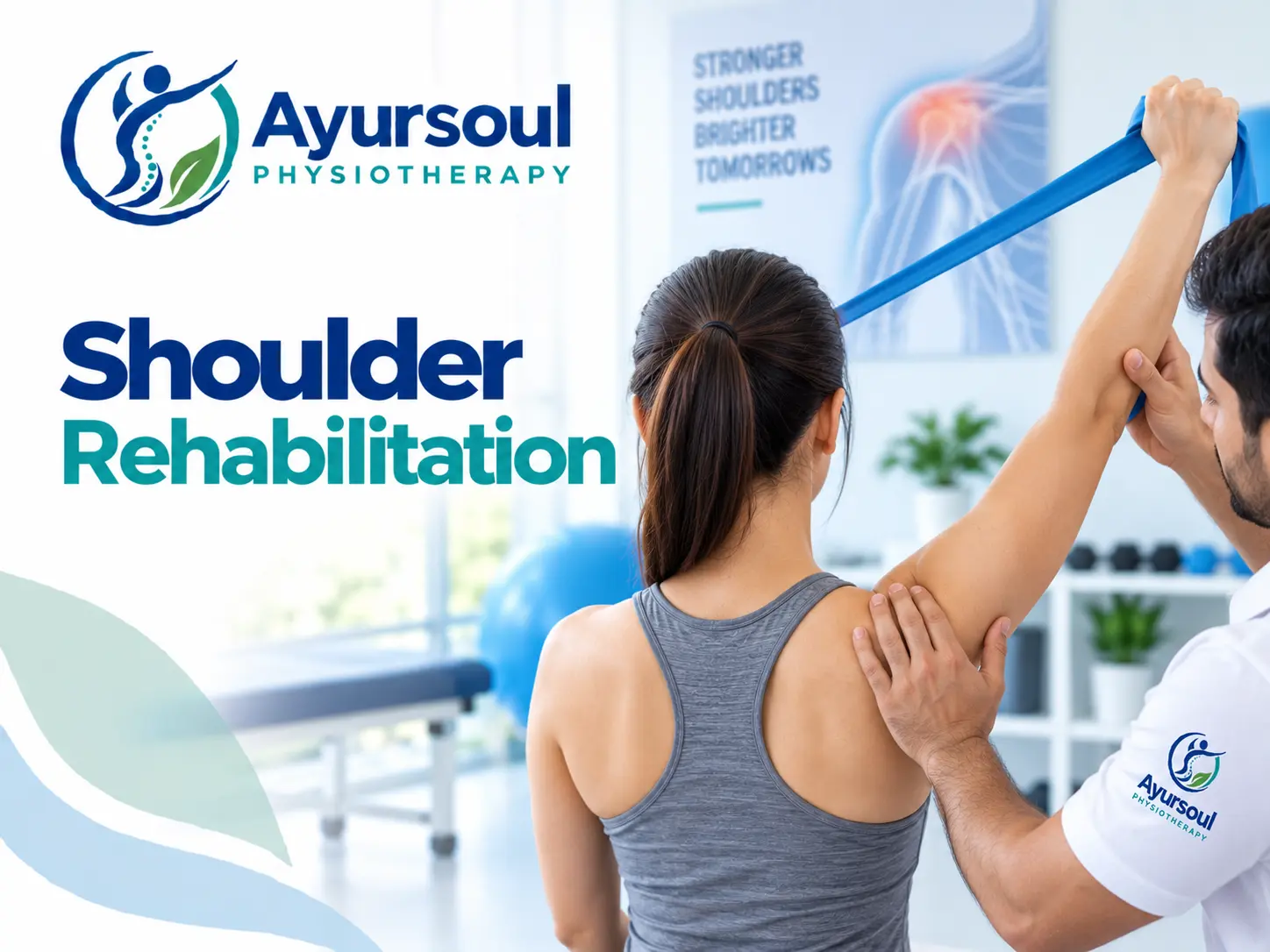
Need Help With Shoulder Rehabilitation?
If shoulder pain or stiffness is affecting your daily activities, you're welcome to book an assessment with Dr. Ashok K. Anand at Ayursoul Physiotherapy in Sector 75, Noida to discuss a suitable path forward.
Shoulder rehabilitation is a physiotherapy-led process aimed at helping people recover movement, strength, and comfort in the shoulder after an injury, surgery, or a gradual onset of pain and stiffness. The shoulder is one of the most mobile joints in the body, and that mobility comes at the cost of stability, which is part of why shoulder problems are so common — ranging from a nagging ache when reaching overhead to significant stiffness that limits everyday tasks like dressing, driving, or lifting.
People seeking shoulder rehabilitation often describe a mix of symptoms: pain that worsens with certain movements, a catching or clicking sensation, weakness when lifting the arm, or stiffness that has crept up over weeks or months. This is common among people who do repetitive overhead work, athletes involved in throwing or racquet sports, older adults dealing with age-related joint changes, and anyone recovering from a fall, dislocation, or shoulder surgery.
At Ayursoul Physiotherapy, located at Spectrum Mall in Sector 75, Noida, shoulder rehabilitation typically begins with a thorough assessment so that any exercise or hands-on treatment plan is matched to what is actually going on with your shoulder, rather than a one-size-fits-all routine. Depending on the findings, physiotherapy may help improve range of motion, support pain management, and guide a gradual return to normal activity, though the right approach and expected timeline vary from person to person.

Common Symptoms of Shoulder Rehabilitation
- Pain when lifting the arm overhead or to the side
- Stiffness that limits how far the shoulder can move in one or more directions
- A dull ache that worsens at night or when lying on the affected side
- Weakness when carrying, pushing, or lifting objects
- A clicking, catching, or grinding sensation during shoulder movement
- Reduced ability to reach behind the back (e.g., fastening a bra, tucking in a shirt)
- Pain radiating from the shoulder into the upper arm
- Difficulty with everyday tasks such as combing hair, dressing, or driving
Common Causes & Risk Factors
Shoulder problems can develop suddenly, such as after a fall, a sports injury, or a dislocation, or gradually over time as a result of repetitive strain, postural habits, or degenerative changes in the joint and surrounding tissues. In many cases, more than one factor is involved, and a physiotherapist may look at your overall shoulder and upper-body mechanics rather than focusing on a single cause.
- Repetitive overhead activity (sports, certain occupations, gym training)
- Rotator cuff strain or tears, partial or complete
- Frozen shoulder (adhesive capsulitis), which can develop without an obvious injury
- Shoulder impingement or bursitis-related irritation
- Trauma such as a fall onto an outstretched arm or a direct blow
- Post-surgical recovery, including after fracture fixation or joint procedures
- Poor posture or prolonged desk and screen use affecting shoulder mechanics
- Age-related wear and reduced tissue flexibility
Because the underlying cause shapes the recommended approach, physiotherapists generally avoid treating every shoulder complaint the same way — what helps one person's impingement-type pain may not be appropriate for another person's post-dislocation instability.
How Physiotherapy Helps
Physiotherapy for shoulder rehabilitation generally focuses on restoring pain-free movement, rebuilding strength around the shoulder girdle, and helping the joint move efficiently again during daily and functional activities. Depending on your assessment findings, a physiotherapist may use a combination of manual therapy, guided exercise, and modalities available at the clinic to work toward these goals — the specific mix depends on your condition, the stage of your recovery, and how your body is responding along the way.
At Ayursoul Physiotherapy, treatment may draw on approaches such as manual therapy, medical acupuncture, dry needling, or electrotherapy and ultrasound therapy when clinically appropriate, alongside a structured exercise program. In many cases, progress is gradual and reviewed over multiple sessions, since shoulder tissues often need time to adapt, and physiotherapy is generally most effective when it is part of a consistent, supervised plan rather than a single visit.
What to Expect at Assessment
An initial shoulder assessment usually starts with a discussion of your symptoms, how and when they began, any prior injuries or surgeries, and what activities aggravate or ease the pain. The physiotherapist will typically observe your posture and shoulder positioning, then assess active and passive range of motion, muscle strength around the shoulder and shoulder blade, and specific movement patterns that may be contributing to your symptoms. Depending on what is found, they may also screen the neck and upper back, since shoulder pain can sometimes be influenced by issues elsewhere in the upper body. This assessment helps shape a treatment plan tailored to your specific presentation rather than a generic protocol.
How Treatment May Be Approached
The exact mix used depends on your assessment — not every technique below applies to every person.
Manual Therapy
Hands-on techniques may be used to help ease stiffness, improve joint mobility, and reduce muscular tension around the shoulder and shoulder blade, depending on assessment findings.
Mobility Exercises
Targeted mobility work can help gradually restore range of motion, particularly in cases of stiffness such as frozen shoulder or post-surgical restriction.
Strengthening
Progressive strengthening of the rotator cuff and shoulder blade muscles may be introduced as pain allows, to support joint stability and reduce the likelihood of recurring strain.
Stretching
Guided stretching may be included to address muscle tightness that can restrict shoulder movement or contribute to compensatory postures.
Posture Education
Simple posture and ergonomic guidance may be discussed, especially for people whose shoulder symptoms are linked to desk work or repetitive overhead tasks.
Electrotherapy
Modalities such as ultrasound therapy or electrotherapy may be used alongside exercise-based treatment when clinically appropriate, as part of a broader pain-management approach.
Functional Rehabilitation
Later-stage rehabilitation may focus on translating improved strength and mobility back into daily, occupational, or sport-specific movements relevant to your routine.
Frequently Asked Questions
How long does shoulder rehabilitation usually take?
Recovery timelines vary widely depending on the underlying cause, how long symptoms have been present, and how the body responds to treatment. Some people notice improvement within a few weeks, while conditions like frozen shoulder can take several months. A physiotherapist can give you a more specific idea after assessing your shoulder.
Can physiotherapy help with frozen shoulder?
Physiotherapy is commonly used to support people with frozen shoulder, often focusing on gradual mobility work and pain management depending on which stage the condition is in. Results and timelines vary from person to person, so an individual assessment is important before starting treatment.
Do I need a doctor's referral before starting shoulder physiotherapy?
A referral is not always required to begin a physiotherapy assessment, but if you have had recent surgery, a suspected fracture, or another doctor-diagnosed condition, it is helpful to share that information so the treatment plan can be adjusted accordingly.
Is it normal for shoulder exercises to feel uncomfortable at first?
Some mild discomfort during graded exercise can be a normal part of rehabilitation, but sharp or worsening pain is not something to push through. Your physiotherapist can help you understand what level of discomfort is reasonable for your specific condition and adjust the program if needed.
Can I continue going to the gym while doing shoulder rehabilitation?
This depends on your specific condition and stage of recovery. In many cases, certain exercises may need to be modified or temporarily avoided, while others can continue. It's best to discuss your gym routine with your physiotherapist so they can guide you on what is appropriate.
What does a first shoulder physiotherapy session involve?
A first session generally includes a discussion of your symptoms and history, followed by a physical assessment of shoulder movement, strength, and posture. Based on this, the physiotherapist may begin initial treatment and outline a plan for follow-up sessions.
Will I need surgery for my shoulder problem?
Not necessarily. Many shoulder conditions are managed with physiotherapy and conservative care, though some cases may require a doctor's evaluation for further options. Physiotherapy does not replace medical or surgical care where it is genuinely needed, and your physiotherapist can advise if a medical referral seems appropriate.
Clinical Evidence & References
The physiotherapy approaches discussed on this page are informed by published clinical research and evidence-based rehabilitation literature. Selected references are provided below for further reading.
-
Diercks R, Bron C, Dorrestijn O, Meskers C, Naber R, de Ruiter T, et al. Guideline for diagnosis and treatment of subacromial pain syndrome: a multidisciplinary review by the Dutch Orthopaedic Association. Acta Orthop. 2014;85(3):314-22. PMID: 24847788. DOI: 10.3109/17453674.2014.920991.
Clinical practice guideline A Dutch multidisciplinary guideline advises treating subacromial shoulder pain non-surgically first, with specific low-intensity, high-frequency exercise, finding no convincing evidence surgery works better.
-
Page MJ, Green S, McBain B, Surace SJ, Deitch J, Lyttle N, et al. Manual therapy and exercise for rotator cuff disease. Cochrane Database Syst Rev. 2016;2016(6):CD012224. PMID: 27283590. DOI: 10.1002/14651858.CD012224.
Cochrane review In the only high-quality placebo-controlled trial, combined manual therapy and exercise for rotator cuff disease showed no clinically important benefit; other evidence was mostly low or very low quality.
-
Page MJ, Green S, Kramer S, Johnston RV, McBain B, Chau M, et al. Manual therapy and exercise for adhesive capsulitis (frozen shoulder). Cochrane Database Syst Rev. 2014;2014(8):CD011275. PMID: 25157702. DOI: 10.1002/14651858.CD011275.
Cochrane review For frozen shoulder, manual therapy plus exercise was probably less effective than a steroid injection at seven weeks, with similar results by 6-12 months; other evidence is mostly low quality.
-
Steuri R, Sattelmayer M, Elsig S, Kolly C, Tal A, Taeymans J, et al. Effectiveness of conservative interventions including exercise, manual therapy and medical management in adults with shoulder impingement: a systematic review and meta-analysis of RCTs. Br J Sports Med. 2017;51(18):1340-1347. PMID: 28630217. DOI: 10.1136/bjsports-2016-096515.
Systematic review and meta-analysis In shoulder impingement, exercise reduced pain more than non-exercise controls, and adding manual therapy helped only at short-term follow-up; overall evidence quality was very low.
-
Liu L, Huang QM, Liu QG, Ye G, Bo CZ, Chen MJ, et al. Effectiveness of dry needling for myofascial trigger points associated with neck and shoulder pain: a systematic review and meta-analysis. Arch Phys Med Rehabil. 2015;96(5):944-55. PMID: 25576642. DOI: 10.1016/j.apmr.2014.12.015.
Systematic review and meta-analysis Across 20 trials, dry needling reduced neck and shoulder trigger-point pain versus sham or control short- and medium-term, though other therapies and injection needling outperformed it medium-term.
-
Parreira Pdo C, Costa Lda C, Hespanhol LC Jr, Lopes AD, Costa LO. Current evidence does not support the use of Kinesio Taping in clinical practice: a systematic review. J Physiother. 2014;60(1):31-9. PMID: 24856938. DOI: 10.1016/j.jphys.2013.12.008.
Systematic review Across 12 trials in musculoskeletal conditions, including two in shoulder pain, Kinesio Taping was no better than sham taping or other treatments; apparent benefits were small or from low-quality trials.
-
Pandey V, Madi S. Clinical Guidelines in the Management of Frozen Shoulder: An Update! Indian J Orthop. 2021;55(2):299-309. PMID: 33912325. DOI: 10.1007/s43465-021-00351-3.
Narrative review A narrative review reports most people with frozen shoulder improve gradually with combined conservative treatment over 12-18 months, though the best single treatment remains uncertain.