
Exercise Therapy & Rehabilitation in Noida
Guided exercise therapy & rehabilitation in Noida at Ayursoul Physiotherapy, Sector 75 - personalised programmes for recovery, strength, and mobility.
Visit Ayursoul Physiotherapy Clinic
Ayursoul Healthcare, Spectrum Mall, Sector 75, Noida, Uttar Pradesh
Open daily: 10:00 AM – 8:00 PM
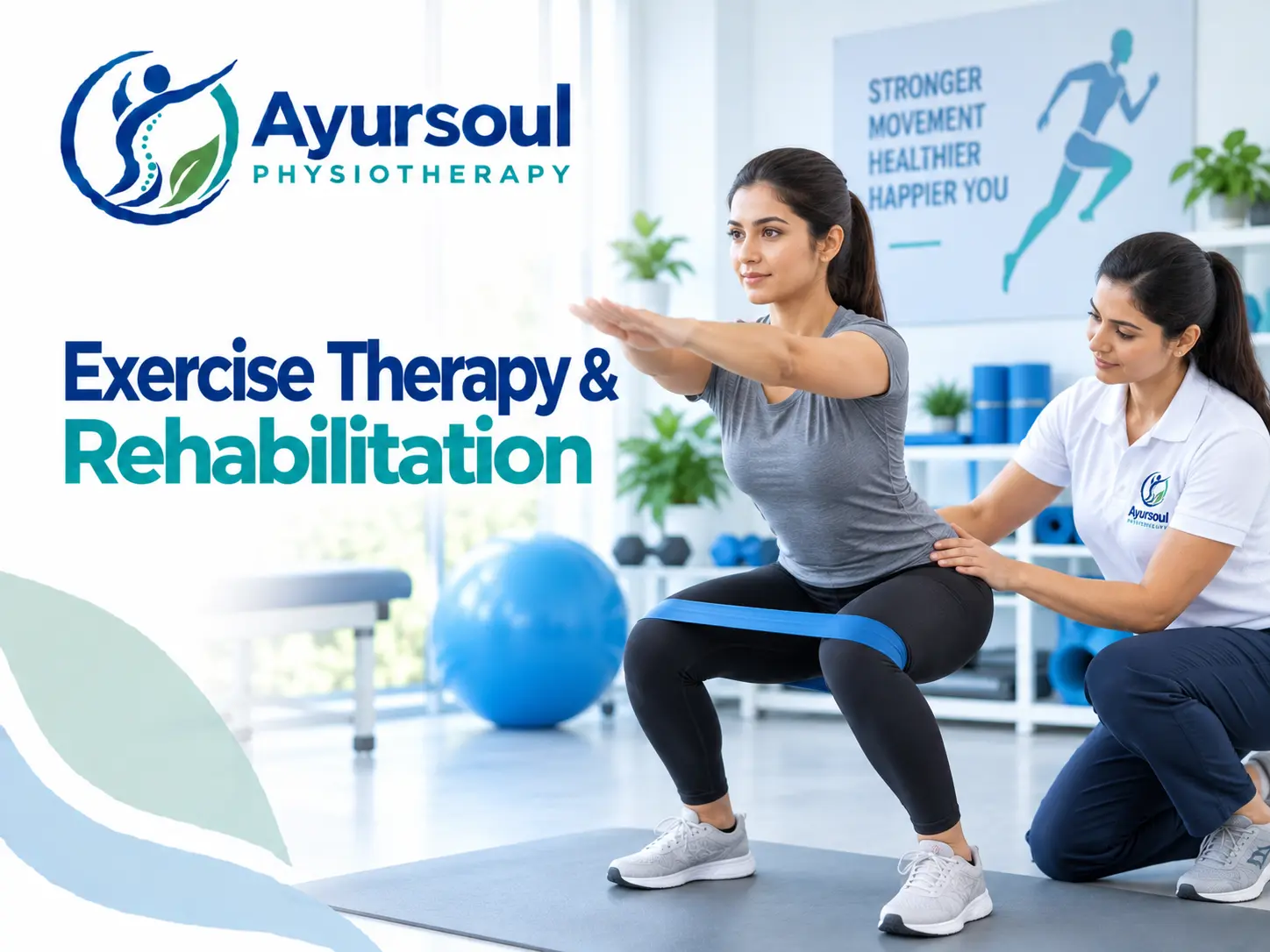
Need Help With Exercise Therapy & Rehabilitation?
If ongoing weakness, stiffness, or difficulty with everyday movement is holding you back, Dr. Ashok K. Anand at Ayursoul Physiotherapy in Sector 75, Noida, can assess your condition and discuss whether a guided exercise therapy and rehabilitation programme may be right for you.
Exercise therapy is a structured, physiotherapist-guided form of movement and rehabilitation used to help the body recover strength, mobility, and function after injury, surgery, illness, or a period of inactivity. Unlike a generic gym routine, each exercise is selected, dosed, and progressed based on an individual's specific condition, current capacity, and recovery goals, and is typically adjusted as the person improves.
People are commonly referred for exercise therapy after events such as an orthopaedic surgery, a soft tissue or ligament injury, a musculoskeletal condition like chronic back or knee pain, or a period of deconditioning following illness or prolonged bed rest. Others seek it out simply because they have noticed ongoing weakness, stiffness, poor balance, or reduced stamina that is limiting their daily activities.
At Ayursoul Physiotherapy in Sector 75, Noida, exercise therapy and rehabilitation programmes are built around a proper assessment rather than a fixed routine, so the plan can reflect what is actually appropriate for that person's stage of recovery. Depending on the underlying condition, this approach may be combined with other treatments such as manual therapy or electrotherapy when clinically indicated after assessment.

Common Symptoms of Exercise Therapy & Rehabilitation
- Muscle weakness following an injury, surgery, or a long period of inactivity
- Stiffness or a noticeable reduction in joint range of motion
- Pain or discomfort that increases with specific movements or activities
- Difficulty with everyday tasks such as climbing stairs, standing up from a chair, or lifting objects
- Poor balance, unsteadiness, or a fear of falling
- Reduced stamina or getting tired more quickly during routine activity
- Compensatory or altered movement patterns to avoid discomfort
- Slower-than-expected progress in recovery after an orthopaedic or medical event
Common Causes & Risk Factors
The need for exercise therapy and rehabilitation usually stems from an event or process that has reduced strength, mobility, or movement confidence in some part of the body. In many cases it follows a clearly identifiable trigger, though gradual deconditioning over time can also be a factor.
- Recovery after orthopaedic surgery, such as joint replacement or ligament repair
- Sports injuries, sprains, strains, or fractures
- Chronic musculoskeletal conditions such as osteoarthritis or persistent back or neck pain
- Workplace or repetitive strain injuries
- Extended bed rest or hospitalisation following illness
- Neurological conditions affecting movement and coordination
- General deconditioning linked to a sedentary lifestyle or ageing
How Physiotherapy Helps
Physiotherapy-led exercise therapy generally works by gradually reintroducing safe, appropriate movement in a way that respects the tissue's stage of healing and the individual's current capacity. After assessment, a physiotherapist may design a programme that progresses through phases, starting with gentle mobility or pain-relief-focused movement and building toward strengthening, endurance, and functional retraining, depending on the person's response.
The goal in many cases is not just to reduce symptoms but to help restore the ability to perform daily activities, work tasks, or sport-specific movements with greater confidence. Because recovery timelines and needs vary considerably between individuals, exercise therapy is generally most effective when it is supervised, reviewed regularly, and adjusted as progress is made, rather than followed as a one-size-fits-all routine.
What to Expect at Assessment
An initial assessment for exercise therapy typically begins with a detailed history, including how and when the issue started, any surgery or diagnosis involved, current pain levels, and the specific activities that have become difficult. The physiotherapist may then carry out a movement and functional assessment, checking joint range of motion, muscle strength, posture, balance, and movement patterns to identify areas that need attention. Based on these findings, short and longer-term goals are usually discussed together with the patient so the exercise programme can be tailored to their condition, fitness level, and what they want to be able to do again.
How Treatment May Be Approached
The exact mix used depends on your assessment — not every technique below applies to every person.
Therapeutic Exercise
A structured set of exercises may be prescribed to address the specific deficits identified during assessment, such as weakness, stiffness, or poor movement control, and progressed gradually over time.
Mobility Exercises
When a joint or region has become stiff, gentle mobility work may be introduced early on to help restore comfortable range of motion before more demanding exercise is added.
Strengthening
Targeted strengthening exercises can be used to rebuild muscle support around an affected joint or region, which may help reduce strain and support more stable movement over time.
Stretching
Stretching techniques may be included to help address tightness in specific muscle groups that could be limiting movement or contributing to compensatory patterns.
Balance Training
For individuals with unsteadiness or a fall risk, balance and proprioception exercises may be incorporated to help support stability during daily activities.
Movement Retraining
Where compensatory or altered movement habits have developed, a physiotherapist may work on retraining movement patterns to encourage more efficient, comfortable mechanics.
Functional Rehabilitation
As recovery progresses, exercises may be adapted to more closely resemble real-world tasks, such as stair climbing, lifting, or specific work or sport movements, to help support return to normal activity.
Frequently Asked Questions
What exactly is exercise therapy and how is it different from just working out?
Exercise therapy is a physiotherapist-guided programme where specific exercises are chosen, dosed, and progressed based on an individual's condition and assessment findings, rather than a general fitness routine. It is typically reviewed and adjusted regularly depending on how a person responds.
Do I need a doctor's referral to start exercise therapy?
A referral is not always required, though if you have a recent surgery, diagnosed medical condition, or are under a doctor's care, sharing those details helps the physiotherapist plan a programme appropriate to your situation.
Is exercise therapy safe if I'm currently in pain?
In many cases, appropriately dosed movement can be included even when there is some discomfort, but this depends on the underlying cause and needs to be confirmed through an assessment first. Certain red-flag symptoms should be evaluated medically before starting exercise.
How soon after surgery can I start exercise-based rehabilitation?
This varies by procedure and depends on your surgeon's guidance and healing timeline, so it is usually decided on a case-by-case basis after assessment and, where relevant, in line with your surgeon's instructions.
How many sessions will I need before I see improvement?
This depends on the condition, its severity, and individual factors like age and general health, so it is difficult to state a fixed number. A physiotherapist can typically give a more specific expectation after the initial assessment and review of early progress.
Will I have to do exercises at home as well?
In many rehabilitation programmes, a home exercise component is included alongside in-clinic sessions, since consistent practice can support progress between visits. Your physiotherapist would guide you on what is appropriate for your stage of recovery.
Can exercise therapy help with chronic conditions like arthritis, not just injuries?
Yes, exercise therapy is commonly used to support management of chronic musculoskeletal conditions as well as acute injuries, though the goals and approach may look quite different depending on the condition and what assessment reveals.
What should I bring to my first exercise therapy session?
Comfortable clothing that allows easy movement is generally recommended, along with any relevant medical reports, scans, or surgical notes if you have them, as these can help the physiotherapist plan your assessment and programme.
Clinical Evidence & References
The physiotherapy approaches discussed on this page are informed by published clinical research and evidence-based rehabilitation literature. Selected references are provided below for further reading.
-
Bannuru RR, Osani MC, Vaysbrot EE, Arden NK, Bennell K, Bierma-Zeinstra SMA, et al. OARSI guidelines for the non-surgical management of knee, hip, and polyarticular osteoarthritis. Osteoarthritis Cartilage. 2019;27(11):1578-1589. PMID: 31278997. DOI: 10.1016/j.joca.2019.06.011.
Clinical practice guideline OARSI guidelines name arthritis education and structured land-based exercise programmes as core treatments for knee, hip and multi-joint osteoarthritis.
-
Bove AM, Carroll LA, Cone S, Dibblee P, Hensley CP, Lenington K, et al. Clinical practice guideline for physical therapist management of total knee arthroplasty: revision 2026. Phys Ther. 2026;106(7). PMID: 42506877. DOI: 10.1093/ptj/pzag058.
Clinical practice guideline An American Physical Therapy Association guideline, based on a systematic review, sets out 20 recommendations for physical therapist management after total knee replacement.
-
Wainwright TW, Gill M, McDonald DA, Middleton RG, Reed M, Sahota O, et al. Consensus statement for perioperative care in total hip replacement and total knee replacement surgery: Enhanced Recovery After Surgery (ERAS(®)) Society recommendations. Acta Orthop. 2020;91(1):3-19. PMID: 31663402. DOI: 10.1080/17453674.2019.1683790.
Consensus statement An international consensus statement lists early mobilisation, with patient education and multimodal pain relief, as best practice around hip and knee replacement surgery.
-
Sherrington C, Fairhall NJ, Wallbank GK, Tiedemann A, Michaleff ZA, Howard K, et al. Exercise for preventing falls in older people living in the community. Cochrane Database Syst Rev. 2019;1(1):CD012424. PMID: 30703272. DOI: 10.1002/14651858.CD012424.pub2.
Cochrane review A Cochrane review of 108 trials found balance and functional exercises cut the rate of falls by about 24% in older adults living at home (high-certainty evidence).
-
Lin I, Wiles L, Waller R, Goucke R, Nagree Y, Gibberd M, et al. What does best practice care for musculoskeletal pain look like? Eleven consistent recommendations from high-quality clinical practice guidelines: systematic review. Br J Sports Med. 2020;54(2):79-86. PMID: 30826805. DOI: 10.1136/bjsports-2018-099878.
Systematic review A review of 11 high-quality guidelines for back, neck, shoulder and osteoarthritis pain recommended addressing exercise and education, and using manual therapy only as an add-on.
-
Searle A, Spink M, Ho A, Chuter V. Exercise interventions for the treatment of chronic low back pain: a systematic review and meta-analysis of randomised controlled trials. Clin Rehabil. 2015;29(12):1155-67. PMID: 25681408. DOI: 10.1177/0269215515570379.
Systematic review and meta-analysis A meta-analysis of 39 trials found exercise gave a small reduction in chronic low back pain; strength and stabilisation programmes helped, while cardio and combined programmes did not.