
Muscle Injury Rehabilitation in Noida
Pulled or torn a muscle? Ayursoul Physiotherapy, Sector 75, Noida offers assessment-led rehabilitation to help you heal and safely return to activity.
Visit Ayursoul Physiotherapy Clinic
Ayursoul Healthcare, Spectrum Mall, Sector 75, Noida, Uttar Pradesh
Open daily: 10:00 AM – 8:00 PM
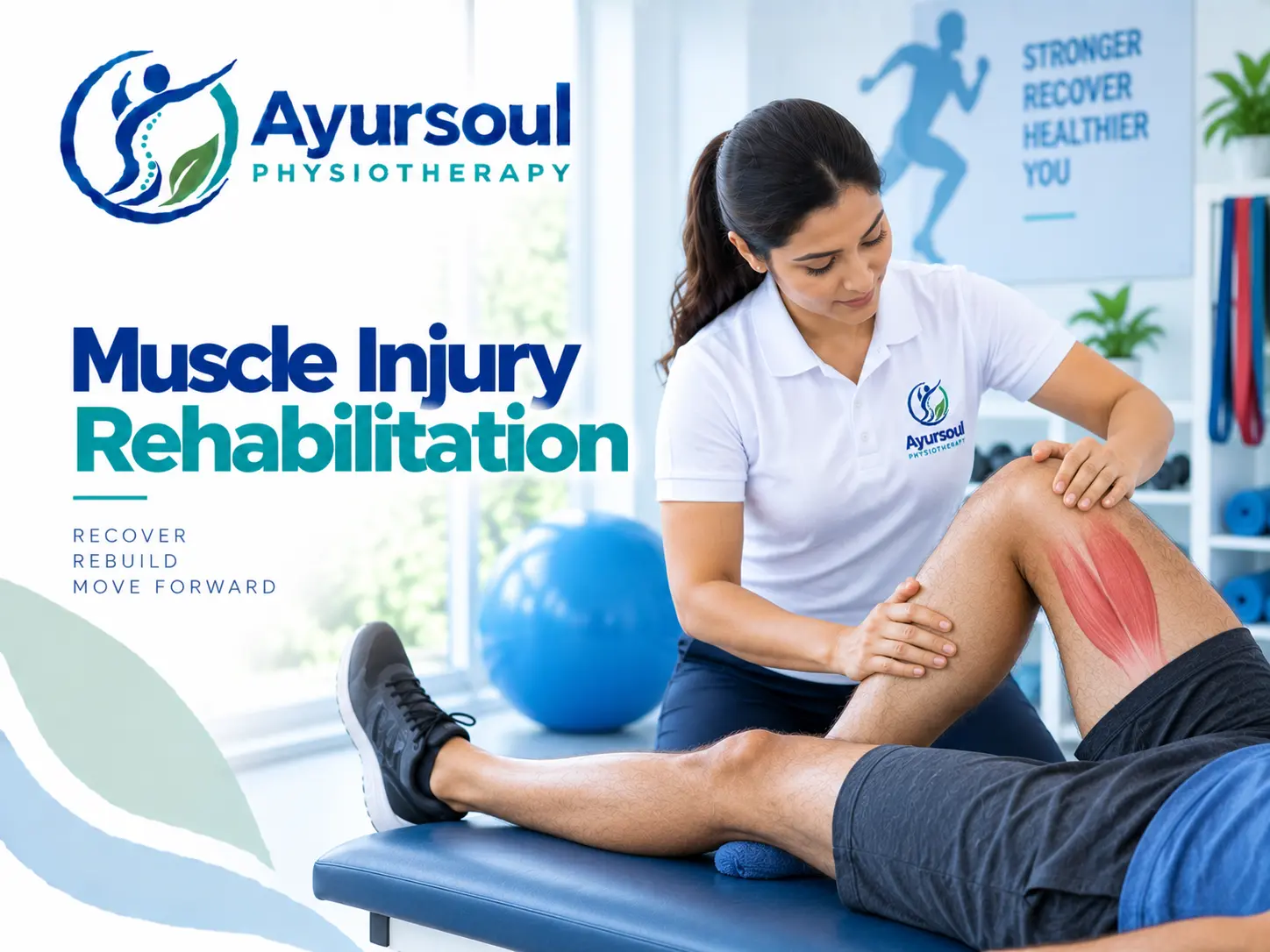
Need Help With Muscle Injury Rehabilitation?
If you are dealing with a muscle strain, tear or ongoing muscle pain, you can book an assessment with Dr. Ashok K. Anand at Ayursoul Physiotherapy in Sector 75, Noida to discuss a rehabilitation plan suited to your injury.
A muscle injury can range from a mild strain that leaves you feeling tight and sore, to a more significant tear that limits how you move for days or weeks. These injuries commonly happen during sport, exercise, sudden lifting, an awkward twist, or even everyday activities when a muscle is asked to do more than it is prepared for. Hamstrings, calves, quadriceps and lower back muscles are frequently affected, though any muscle in the body can be injured.
Common symptoms include sudden pain at the time of injury, swelling, bruising, tightness, and a noticeable drop in strength or flexibility in the area. Muscle injuries are seen across a wide range of people at Ayursoul Physiotherapy in Sector 75, Noida — from weekend athletes and gym-goers to people who simply moved the wrong way while doing a routine task at home or work.
Physiotherapy is often a central part of recovering from a muscle injury. Depending on your condition and how the injury is assessed, a physiotherapist may recommend a combination of hands-on treatment, guided stretching, and a graded exercise programme designed to help the muscle heal, regain strength, and reduce the chances of reinjury when you return to your usual activity.
Common Symptoms of Muscle Injury Rehabilitation
- Sudden, sharp pain at the moment of injury, often during activity or lifting
- Swelling, bruising or discoloration over the affected muscle
- Tightness, stiffness or a pulling sensation in the muscle
- Noticeable weakness or difficulty using the muscle normally
- Pain that increases when the muscle is stretched or contracted
- A palpable knot, spasm or gap felt within the muscle
- Reduced range of motion in the nearby joint
- Difficulty walking, running or bearing weight, depending on the muscle involved
Common Causes & Risk Factors
Muscle injuries usually occur when a muscle is stretched, loaded or contracted beyond what it is conditioned to handle at that moment. This can happen suddenly, as in a sprint or an awkward lift, or gradually, through repeated overuse without adequate recovery.
- Sudden or forceful movements, such as sprinting, jumping or changing direction quickly
- Inadequate warm-up before exercise or sport
- Muscle fatigue, which can reduce a muscle's ability to absorb load safely
- Poor flexibility or muscle imbalance around a joint
- A previous muscle injury that has not fully healed or been rehabilitated
- Direct trauma, such as a fall, collision or blow to the muscle
- Lifting heavy loads with poor technique
In many cases, more than one of these factors contributes together, which is why a physiotherapist may look at your overall activity pattern and not just the injured muscle in isolation.
How Physiotherapy Helps
Physiotherapy for a muscle injury generally aims to support the body's natural healing process while gradually restoring flexibility, strength and function. In the earlier stages, when clinically appropriate, a physiotherapist may use manual therapy and modalities such as ultrasound therapy or electrotherapy to help manage pain and swelling and support tissue recovery. As healing progresses, the focus typically shifts toward controlled stretching and a graded strengthening programme.
Because every muscle injury and every person's activity demands are different, the exact approach depends on the severity of the injury, which muscle is involved, and your individual goals, whether that is returning to sport, work, or simply moving comfortably again. A physiotherapist can help sequence this recovery so that load is increased at a pace the healing tissue can tolerate, which may help reduce the risk of setbacks or reinjury.
What to Expect at Assessment
An assessment for a muscle injury at Ayursoul Physiotherapy typically begins with a detailed history — how and when the injury occurred, the nature of the pain, and how it has behaved since. This is usually followed by a physical examination that may include observation for swelling or bruising, gentle palpation of the muscle, and testing of range of motion, strength and flexibility in the affected area compared with the unaffected side. A functional movement assessment may also be carried out to understand how the injury is affecting activities relevant to you, such as walking, squatting, running or specific sporting movements. This assessment helps guide a treatment plan suited to your particular injury rather than a one-size-fits-all approach.
How Treatment May Be Approached
The exact mix used depends on your assessment — not every technique below applies to every person.
Manual Therapy
Hands-on techniques may be used to help reduce muscle tightness and support soft tissue recovery, depending on the stage and severity of the injury.
Electrotherapy
Modalities such as ultrasound therapy may be used in appropriate cases to help manage localized pain and swelling as part of the early treatment plan.
Stretching
Gentle, progressive stretching may be introduced once acute pain has settled to help restore flexibility in the injured muscle.
Strengthening
A graded strengthening programme can be recommended to rebuild muscle capacity in stages, which may help reduce the risk of reinjury.
Therapeutic Exercise
Structured exercise progressions may be used to support a safe, step-by-step return to daily activity, exercise or sport.
Functional Rehabilitation
Later-stage rehabilitation can focus on movement patterns relevant to your work, sport or daily routine, helping prepare the muscle for real-world demands.
Movement Retraining
Where a movement pattern or technique may have contributed to the injury, a physiotherapist may work with you on retraining it to help lower future risk.
Frequently Asked Questions
How long does it usually take to recover from a muscle injury?
Recovery time varies widely depending on the severity of the injury, the muscle involved, and individual factors, and can range from a couple of weeks for a mild strain to several weeks or more for a significant tear. After assessment, a physiotherapist can give you a more specific idea of what to expect for your particular injury.
Should I rest completely or keep moving after a muscle strain?
Complete rest for a prolonged period is generally not recommended, as some gentle, guided movement can support recovery once acute pain has settled. The right balance of rest and activity depends on your injury, which is why an individualized plan after assessment is usually more helpful than generic advice.
When can I start physiotherapy after a muscle injury?
This depends on the severity of the injury and how it is healing. In many cases physiotherapy can begin fairly soon after injury in a modified, gentle form, while more significant injuries may need a short period of relative rest first. A physiotherapist can advise on timing after assessing your specific injury.
Is ice or heat better for a muscle injury?
Ice is commonly used in the first day or two after an acute muscle injury to help manage pain and swelling, while heat may be introduced later to help with stiffness, depending on how the injury is progressing. A physiotherapist can advise on what is appropriate at each stage of your recovery.
Can physiotherapy help with a muscle tear, or will I need surgery?
Many muscle tears, including moderate ones, may respond well to physiotherapy-led rehabilitation, though this depends on the location and severity of the tear. Physiotherapy does not replace medical or surgical care when it is needed, and a physiotherapist can help identify when referral for further medical opinion is appropriate.
How do I know if my muscle injury is serious?
Signs such as being unable to bear weight, a visible deformity, significant swelling, or pain that is not improving over several days can suggest a more serious injury. If you notice these, it is best to seek prompt medical evaluation rather than waiting.
Will I have to stop exercising or playing sport completely?
Not always. Many people are able to continue some form of modified activity while recovering, depending on the injury. A physiotherapist can help design a graded return-to-activity plan so you can stay active safely as the muscle heals.
What happens in a physiotherapy session for a muscle injury at Ayursoul?
A session typically builds on your initial assessment and may include hands-on manual therapy, guided stretching, targeted strengthening exercises, and, when appropriate, modalities such as ultrasound therapy or electrotherapy, all adjusted as your injury progresses.
Clinical Evidence & References
The physiotherapy approaches discussed on this page are informed by published clinical research and evidence-based rehabilitation literature. Selected references are provided below for further reading.
-
Hotfiel T, Seil R, Bily W, Bloch W, Gokeler A, Krifter RM, et al. Nonoperative treatment of muscle injuries - recommendations from the GOTS expert meeting. J Exp Orthop. 2018;5(1):24. PMID: 29931565. DOI: 10.1186/s40634-018-0139-3.
Consensus statement Expert consensus endorsed early PRICE care (protection, rest, ice, compression, elevation) but found most nonoperative muscle-injury treatments rely on best practice rather than strong evidence.
-
Ishøi L, Krommes K, Husted RS, Juhl CB, Thorborg K. Diagnosis, prevention and treatment of common lower extremity muscle injuries in sport - grading the evidence: a statement paper commissioned by the Danish Society of Sports Physical Therapy (DSSF). Br J Sports Med. 2020;54(9):528-537. PMID: 31937579. DOI: 10.1136/bjsports-2019-101228.
Systematic review This graded evidence review found lengthening hamstring exercises gave faster return to play and fewer reinjuries than conventional exercises, but evidence certainty was very low to low.
-
Heiderscheit BC, Sherry MA, Silder A, Chumanov ES, Thelen DG. Hamstring strain injuries: recommendations for diagnosis, rehabilitation, and injury prevention. J Orthop Sports Phys Ther. 2010;40(2):67-81. PMID: 20118524. DOI: 10.2519/jospt.2010.3047.
Narrative review An expert clinical guide suggests hamstring rehab combining neuromuscular control exercises with eccentric strengthening and objective return criteria may reduce the high (about one in three) reinjury rate.
-
Opar DA, Williams MD, Shield AJ. Hamstring strain injuries: factors that lead to injury and re-injury. Sports Med. 2012;42(3):209-26. PMID: 22239734. DOI: 10.2165/11594800-000000000-00000.
Narrative review This review lists age, previous injury, strength imbalances, flexibility and fatigue among reported hamstring strain risk factors, while noting the causes of injury remain incompletely understood.
-
Brukner P, Connell D. 'Serious thigh muscle strains': beware the intramuscular tendon which plays an important role in difficult hamstring and quadriceps muscle strains. Br J Sports Med. 2016;50(4):205-8. PMID: 26519522. DOI: 10.1136/bjsports-2015-095136.
Narrative review This review suggests thigh strains involving the intramuscular tendon may need longer rehabilitation and recur more often, though the supporting evidence is described as limited.
-
Sherry MA, Best TM. A comparison of 2 rehabilitation programs in the treatment of acute hamstring strains. J Orthop Sports Phys Ther. 2004;34(3):116-25. PMID: 15089024. DOI: 10.2519/jospt.2004.34.3.116.
Randomized controlled trial In a small trial of 24 athletes, agility and trunk-stabilisation rehab led to far fewer hamstring re-strains than stretching plus isolated strengthening; return-to-sport time did not differ significantly.